


Poland’s political dispute over Zondacrypto has escalated to the highest level of government. Prime Minister Donald Tusk used a parliamentary debate on the president’s veto of the cryptoassets law to cite testimony from an ongoing investigation and accuse politicians linked to the former ruling camp of protecting people connected with serious crimes. Zbigniew Bogucki, head of the Presidential Chancellery, demanded disclosure of prosecutorial decisions made under the current government, while Justice Minister and Prosecutor General Waldemar Żurek responded with a chronology showing that several earlier cases had already been discontinued under the previous PiS government.
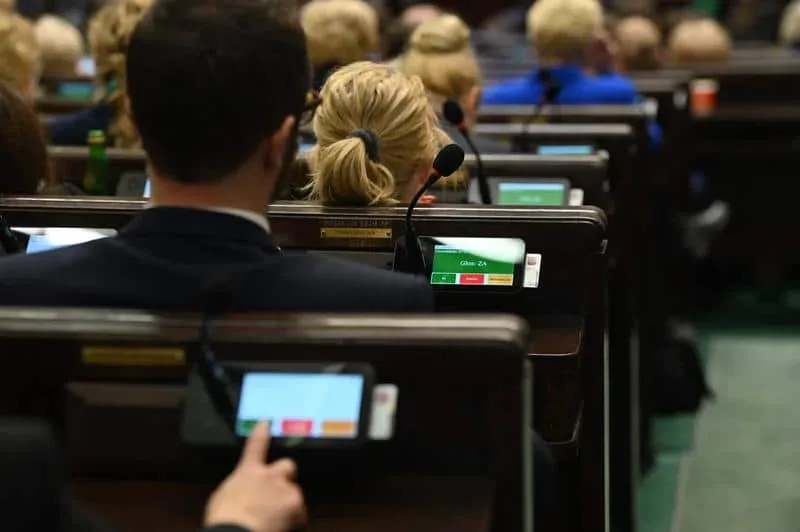
The confrontation took place shortly before the Sejm voted on whether to override President Karol Nawrocki’s veto of legislation regulating the cryptoassets market. The lower house failed to reach the required three-fifths majority. Of 442 MPs present, 241 voted to reject the veto, 198 voted against and three abstained. A total of 266 votes was required.
Tusk cites witness testimony in the Zondacrypto investigation
During his speech, Tusk referred to what he described as evidence gathered in the investigation into Zondacrypto and its predecessor BitBay. He read excerpts from testimony given by a key witness, including allegations that people connected with the company sought political protection and expected intervention in prosecutorial proceedings.
The prime minister argued that the Zondacrypto affair went beyond a financial scandal and spoke of what he called the infiltration of political circles by people linked to the business. The allegations remain part of an ongoing investigation and have not been established by a final court judgment. Politicians targeted by Tusk’s accusations reject his interpretation and accuse the government of using prosecutorial material for political purposes.
Bogucki demands explanations for decisions made after 2023
Zbigniew Bogucki accused Tusk of relying on prosecutors, security services and testimony from people involved in criminal proceedings to attack political opponents. He demanded the publication of information on decisions to discontinue proceedings concerning BitBay and Zondacrypto during the current government’s term.
Bogucki pointed in particular to a prosecutorial decision made in April 2024 and argued that the public should be told why proceedings were discontinued, on what legal grounds and whose interests the decisions served. He also criticised the pace of the government’s work on cryptoasset regulation.
Żurek lists earlier discontinuations under the PiS government
Justice Minister Waldemar Żurek answered by presenting a chronology of earlier prosecutorial decisions. According to his account, proceedings connected with the case were discontinued on 29 March 2019, 12 June 2020 and 15 June 2022. A further decision by the National Prosecutor’s Office on 12 May 2023 upheld the earlier discontinuation and made it final.
Żurek acknowledged that another decision to discontinue one strand of the case was taken in April 2024, after the current coalition had already taken office. He argued, however, that the prosecutor responsible had been appointed and promoted within the prosecution service under the previous leadership. He also said the Financial Supervision Authority was continuing to supplement the evidentiary record.
Sejm again fails to override the presidential veto
The political clash unfolded around the latest attempt to override President Nawrocki’s veto of the cryptoassets law. The bill was intended to create a domestic supervisory framework for the cryptoasset market and give Poland’s Financial Supervision Authority a central regulatory role.
The president has argued that the law would over-regulate the sector and could drive Polish crypto businesses abroad. The government says the veto leaves investors exposed and weakens the state’s ability to supervise the market.
Friday’s vote was the third failed attempt to overcome a presidential veto of legislation in this area.
Zondacrypto investigation has widened in recent months
The National Prosecutor’s Office opened a new investigation into Zondacrypto in April 2026, focusing on suspected large-scale fraud and money laundering. In July, the case was combined with an investigation connected with BitBay and the disappearance of its founder, Sylwester Suszek, who went missing in March 2022.
The investigation has since expanded. Radosław Piesiewicz, president of the Polish Olympic Committee, was detained in August and later placed in pre-trial detention. Prosecutors have accused him of paid protection and of favouring a group of Zondacrypto creditors at the expense of others in connection with the exchange’s threatened insolvency. Piesiewicz has denied wrongdoing.
On 2 September, prosecutors announced further detentions and searches connected with the case. The National Prosecutor’s Office has also published information for creditors following the bankruptcy of the company operating the Zondacrypto exchange.
A financial scandal becomes a political battle
The dispute now has two overlapping dimensions. One concerns the criminal investigation itself, including the collapse of Zondacrypto, the disappearance of Suszek, alleged money laundering, possible political influence and the treatment of creditors. The second concerns responsibility for how prosecutors and regulators handled the company over several years.
For the government, the case has become an argument for tighter cryptoasset supervision. For the Presidential Chancellery and opposition politicians, it has become evidence that the current authorities are selectively presenting prosecutorial material while avoiding scrutiny of decisions made after they took office.
What is clear is that the Zondacrypto affair has moved well beyond the cryptocurrency market. It is now part of a broader confrontation over the prosecution service, political accountability and the state’s ability to supervise fast-growing financial technologies.
Sources: Sejm of the Republic of Poland; National Prosecutor’s Office; Chancellery of the Prime Minister; Polish Radio; Rzeczpospolita; Euronews.



