
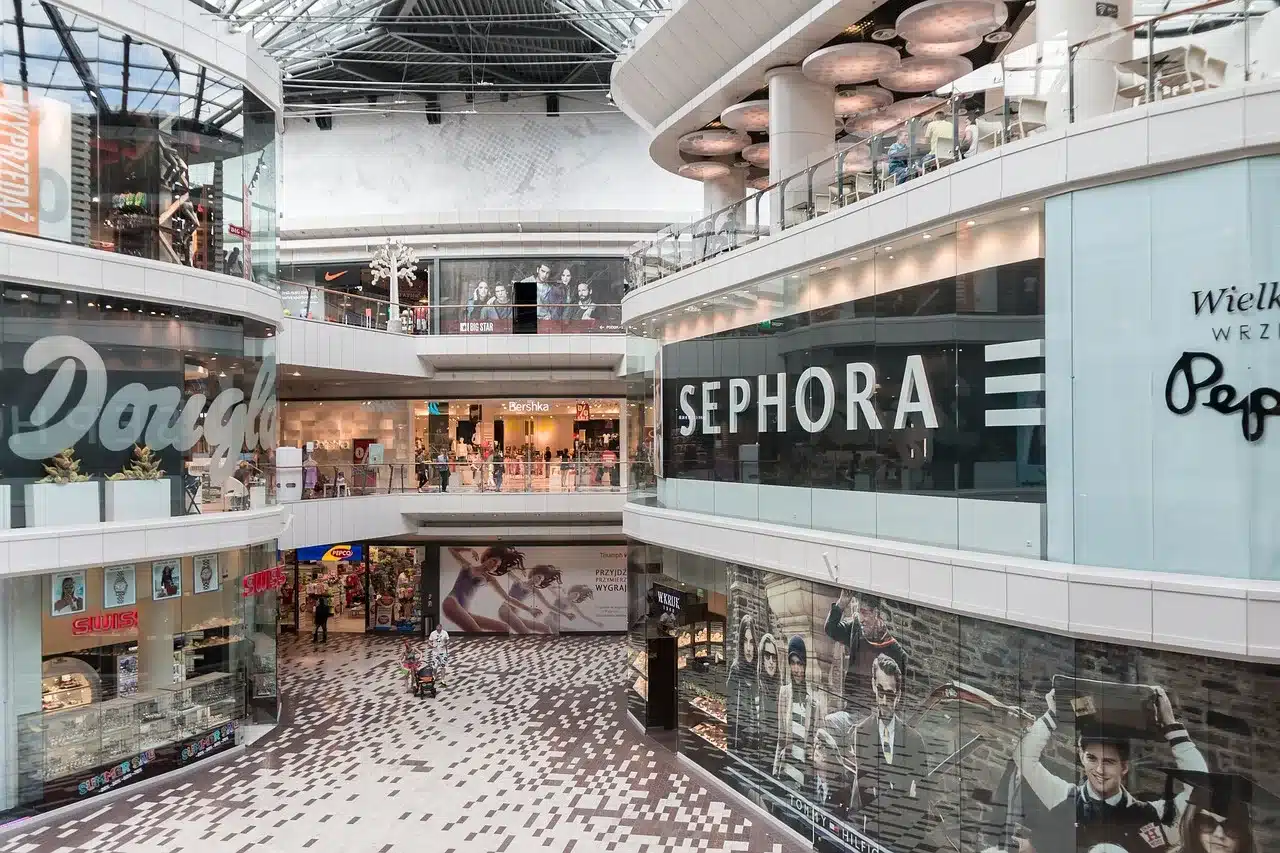


During this year’s summer sales period, shopping malls and retail centers saw 3.9% fewer customers than a year earlier. The average time spent in such venues shortened by 5.2% year-on-year (y/y). The number of visits fell by 1.4% y/y, while their frequency rose by 2.6% y/y. Traffic structure shows that customers most often chose small facilities (5,000–20,000 m²) – 24.9% (vs. 24.8% a year earlier) – and the largest malls (over 60,000 m²) – 23.9% (vs. 24.3%). The least popular were large centers (40,000–60,000 m²) – 11.8% (vs. 12.4% last year). Detailed data indicate that the number of customers fell y/y in all provinces. Visit frequency increased y/y in fourteen provinces and decreased in two.
According to a report by Proxi.cloud, Grupa BLIX, and UCE RESEARCH (based on the behavior of more than 1.4 million consumers), during this year’s summer sales (June 26–August 31) the number of customers in malls and shopping centers was 3.9% lower than a year earlier. The number of visits decreased by 1.4% y/y. The average time spent in these venues fell by 5.2% y/y. In contrast, visit frequency increased by 2.6% y/y.
“A slight decline in customer numbers and a shorter average stay in malls signal that consumers are changing how they use these places, but there’s no reason for alarm. The rise in visit frequency shows Poles still visit regularly and willingly; they just do so more often and with a clearer purpose, spending less time on site. More and more, visits are tied to a specific task—picking up an order, quick shopping, or a short meal,” says Mateusz Chołuj, co-author of the report from tech company Proxi.cloud.
Dr. Krzysztof Łuczak, co-author of the report from Grupa BLIX, adds that these shifts reflect growing price awareness and the expansion of e-commerce, which moves some purchases online and prompts more planned mall trips. “That implies shorter, less spontaneous but more frequent visits. The shorter average stay stems more from customer intent than from conditions within malls,” he notes.
“For operators and tenants, it’s a clear signal to invest in solutions that speed up the shopping journey—from intuitive in-mall navigation and easy access to promotions to self-checkout and click-and-collect services. Such conveniences improve customer comfort and can build loyalty. Pro-customer investments make sense and will become an increasingly important draw,” argues Marcin Lenkiewicz, another co-author of the report from Grupa BLIX.
According to the expert, this is not a decline in interest in summer sales per se, but rather a less intense demand for seasonal goods. “This summer was cooler than expected. Consumers may have felt less need to buy light clothing, beachwear, or accessories because the weather didn’t provide many opportunities to use them,” says Mateusz Chołuj. “Another factor is that online channels often launch promotions earlier than brick-and-mortar stores, satisfying part of customer demand. For malls, that’s a cue to start discount campaigns earlier.”
Traffic Structure by Center Size
The report also details traffic by facility size (five categories, from under 5,000 m² to over 60,000 m²). During this year’s summer sales, small centers and malls (5,000–20,000 m²) had the largest share—24.9% (vs. 24.8% a year earlier). Next were the largest venues (over 60,000 m²)—23.9% (vs. 24.3%). Large malls (40,000–60,000 m²) ranked last—11.8% (vs. 12.4%).
“Data show customers are choosing smaller malls more often due to proximity, easy access, and the ability to shop quickly. The largest centers still attract a big share of traffic, but their share is edging down, suggesting visits are more occasional and planned. Medium and large facilities are losing ground because they offer neither the full experience of the biggest sites nor the convenience of small centers. Location and the right brand mix are crucial. Sales offers matter, but convenience and speed ultimately decide where customers go,” analyzes Dr. Krzysztof Łuczak.
Regional Breakdown
Detailed data also show that during this year’s summer sales, customer numbers fell y/y in every province. The largest declines were in Kuyavian-Pomeranian (-6.4%) and Świętokrzyskie (-6.3%). The smallest decrease was in Łódzkie (-2.4%). The number of visits fell y/y in ten provinces and rose in six. The biggest drop was in Świętokrzyskie (-7.6%), while the largest increase was in Pomeranian (+2.7%).
“The drop in customer numbers and visits across provinces reflects the national trend. Differences may be influenced by local offers, renovations at specific centers, or regional wealth levels. The largest overall declines were in Świętokrzyskie, which—per many economic rankings—is not among the wealthiest areas. Meanwhile, the uptick in visits in Pomeranian may stem from increased tourist traffic during weather that was poor by vacation standards,” explains Mateusz Nowak, co-author of the report from Proxi.cloud.
During this year’s summer sales, visit frequency increased y/y in fourteen provinces and declined in two. The strongest increases were in Pomeranian (+5.6%) and Lubuskie (+4.8%). Decreases were recorded in Świętokrzyskie (-1.4%) and Silesian (-0.7%). Average visit time fell y/y in all provinces, most in Podkarpackie (-6.4%), Łódzkie (-6.3%), and West Pomeranian (-6.3%). The mildest decline was in Świętokrzyskie (-3.6%).
“Changes in visit frequency are derivatives of changes in visit counts and customer numbers. Meanwhile, shifts in average stay length do not deviate markedly from the national figure in any province. This indicates that consumer behavior patterns are very similar across Poland. The shorter average visit time shouldn’t worry malls and shopping centers; much of it results from customer-service improvements that have already been implemented,” says Mateusz Nowak.
Summary: According to Mateusz Chołuj, the pattern of behavior is similar nationwide, with minor local differences. For malls and shopping centers, this means focusing on making shopping easier and faster—because that’s what customers expect, regardless of province.
Methodology
The analysis was conducted by Proxi.cloud and Grupa BLIX, in cooperation with UCE RESEARCH, using data from June 26 to August 31, 2025, compared with the same period in 2024, excluding public holidays and non-trading Sundays. It covered consumer behavior in shopping malls and retail centers.
- Sample size: over 1,420,810 unique consumers.
- For an entry into a geofence to be recorded as a customer visit to a given mall or shopping center, the stay had to last at least 5 minutes and no more than 6 hours.
- In total, traffic at 714 facilities was analyzed. Locations were sourced from mall and retail network websites and Google Maps.
- Centers were classified by size: over 60,000 m² (largest); 40,000–60,000 m² (large); 20,000–40,000 m² (medium); 5,000–20,000 m² (small); under 5,000 m² (smallest).
Data collection: via a network of mobile apps using proprietary geofencing technology to identify entries and exits from designated zones, leveraging mobile device location services. The solution collects data passively and offers high location accuracy (2–20 meters, depending on the device’s positioning method). The technology allows full control over location accuracy, with each geofence radius tailored to building size. Time spent at each location is also known, adding protection against counting nearby pedestrian traffic or staff movement within analyzed sites.



