


Scientists have developed molecular motors that can be powered by sunlight instead of the intense light produced by laboratory sources. These microscopic machines convert light energy into the directional movement of one part of a molecule relative to another. In the future, they could be used in applications ranging from smart materials capable of capturing and releasing water to highly precise drug-delivery systems.
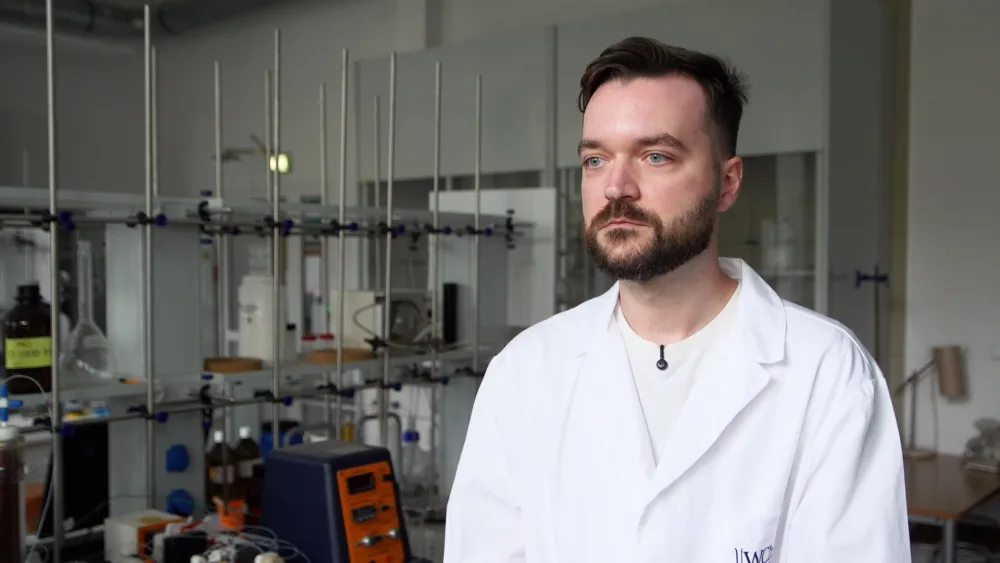
Research into sunlight-powered molecular motors was carried out by an international team of scientists that included Dr Wojciech Danowski from the University of Warsaw. The results were published in 2026 in the Journal of the American Chemical Society.
“A motor is a machine that converts chemical energy contained in a fuel-air mixture into the unidirectional, continuous rotation of a crankshaft. Molecular motors work in an analogous way – they convert a form of energy into the unidirectional rotation of one part of a molecule relative to another,” Dr Danowski, an assistant professor at the Faculty of Chemistry at the University of Warsaw, told the Newseria news agency.
Synthetic counterparts of nature’s molecular machines
Chemists are developing synthetic equivalents of biological molecular machines found in the cells of living organisms. These are usually large protein complexes or proteins that perform specific functions inside cells.
One example is ATP synthase, a protein complex that rotates in one direction and converts mechanical work into chemical energy. Another example is provided by so-called walking proteins, which transport cargo inside cells.
In synthetic systems, light can be used to set molecular motors in motion. Their behaviour can also be precisely controlled by designing the chemical structure of the molecule in a particular way.
“In our latest work, we constructed a molecular motor that is powered by sunlight. Instead of using a laboratory light source, such as a light-emitting diode or a laser, which provides high-energy, high-intensity light within a very narrow spectral range – essentially one specific wavelength – our molecular motor can use sunlight, which has much lower intensity and covers a very broad range of wavelengths,” Danowski explains.
Visible light instead of ultraviolet radiation
Research into synthetic molecular machines was recognised with the Nobel Prize in Chemistry in 2016. The award went to Jean-Pierre Sauvage, Fraser Stoddart and Bernard L. Feringa.
One of the main directions in the development of the technology has since been the use of visible light instead of ultraviolet radiation, which has traditionally been used to power many light-responsive molecular systems.
“Using visible light is very important because it is a ubiquitous, inexpensive and readily available source of energy. This is what distinguishes it from the light sources typically used in laboratories,” the researcher says.
The motors developed by the team involving Danowski can operate in natural sunlight even when incorporated into a polymer matrix.
The efficiency of the photochemical process responsible for changing the molecular structure reached around 80%, remaining at a similar level both in solution and inside the polymer.
In the future, such molecules could be used to perform mechanical work, including stretching, contracting or changing the shape of a material.
Smart materials that respond to sunlight
According to Danowski, the discovery could ultimately have a wide range of applications, particularly in the development of materials capable of changing their properties in response to light.
“This discovery has considerable potential for future applications, including the construction of smart materials whose properties change under the influence of light. These could, for example, be porous materials that absorb gas or water in the dark and release it when exposed to sunlight,” he says.
Such technology could lead to materials that actively respond to changing environmental conditions.
Textiles exposed to sunlight could potentially change their structure to make dirt easier to remove or to repel dust and water. Car body coatings might one day react in ways that help repair minor scratches.
Windows could automatically adjust their transparency or the amount of heat they allow to pass through, potentially reducing the energy required for air conditioning.
Another possible application is soft robotics. A polymer film containing molecular motors could curl, bend or adopt a programmed shape when exposed to light.
Molecular motors could help capture carbon dioxide
Molecular motors could also find applications in materials designed to capture gases, including carbon dioxide.
In such a system, a porous material could absorb CO2 from the air, while sunlight-powered molecular motors would enable the gas to be released later.
“We can imagine such a porous material as a sponge in which the pores are small enough to selectively capture particular gases from the air. When exposed to sunlight, the movement of molecular motors embedded in the material could release the stored gas so that it could then be stored permanently or used in other chemical processes,” Danowski explains.
One of the biggest challenges in direct air carbon capture today is regenerating the adsorbent. The captured gas has to be released and the material prepared for another cycle of use.
According to the University of Warsaw scientist, this stage can account for around 40% of the energy consumed by the entire process.
If sunlight could be used to regenerate the material, the need for energy from other sources could therefore be significantly reduced.
Targeted drug delivery is another possible application
Scientists are also investigating whether molecular machines could eventually be used to transport and release medicines in a controlled manner inside the human body.
“Imagine that we have a tumour in a particular location and want to deliver a drug molecule, such as a chemotherapy agent, specifically to that area rather than exposing the entire body to the drug,” Danowski says.
“If we have a molecule capable of performing unidirectional rotation, we can imagine that such a system could transport a drug molecule through the complex network of veins and arteries in our body to a specific location selected with the help of light.”
Such an approach could potentially reduce the systemic side effects of some treatments by concentrating the therapeutic substance where it is needed most.
However, substantial scientific and technological barriers remain.
Before molecular machines can be used in medicine, researchers need to develop methods for precisely controlling them inside the body, ensure that the materials are biocompatible and establish manufacturing techniques that would allow them to be produced on a much larger scale.
Practical applications may still be decades away
Despite their potential, molecular motors remain primarily an area of fundamental research.
“Unfortunately, we are still quite far from practical applications. The time horizon we are talking about is around 10, 15 or even 20 years,” Danowski says.
“This is because the synthesis of molecular motors is still difficult and demanding. We are also not yet able to amplify the movement of individual molecules up to the macroscopic scale. In other words, we cannot yet reproduce what nature does when it amplifies the motion of biological molecular machines, for example in our muscles or cells.”
Researchers are currently working to improve the efficiency of molecular motors, expand the range of visible wavelengths capable of driving them and reduce production costs.
Cost and efficiency remain major obstacles
For molecular motors to move from laboratories into commercial technologies, researchers will need to solve two particularly important problems: manufacturing cost and energy-conversion efficiency.
“The main factor limiting the future application of this technology is the cost of producing a molecular motor. At the moment it is very high, but we hope that better methods will eventually be developed that allow molecular motors to be produced on a large scale,” Danowski says.
“Another factor limiting their potential use in the real world is their efficiency, which remains relatively low. I hope, however, that in the future we will be able to achieve much higher efficiency in converting light into mechanical motion.”
If those challenges can be overcome, sunlight-powered molecular machines could eventually become components of a new generation of responsive materials – systems capable of converting an abundant natural energy source directly into controlled motion at the molecular level.



