


A Russian drone struck the locomotive of a Kyiv–Warsaw passenger train just two kilometres from the Polish border on Sunday. Passengers had been evacuated and no casualties were reported. Hours later, US President Donald Trump, speaking during the Irish Open at his family’s golf course in Doonbeg, urged Ukrainian President Volodymyr Zelensky to stop targeting Russian diesel infrastructure because the attacks were contributing to a global fuel shortage. The two developments, occurring on the same day, expose an increasingly stark clash between Ukraine’s military logic and Washington’s economic priorities.
On Sunday, September 13, Russian drones again reached the immediate vicinity of Poland’s border. One struck the engine carriage of a Kyiv–Warsaw passenger train near Yahodyn. Ukrainian authorities said the locomotive had been detached and passengers evacuated after an advance warning of an incoming strike. No one was killed or injured.
Another Russian strike hit a truck roughly 800 metres from the Dorohusk–Yahodyn border crossing. The attack also affected the area around a fuel station and temporarily disrupted border operations. Poland scrambled military aircraft and placed air-defence systems on alert. Polish authorities reported no violation of Polish airspace.
Hours later, Trump tells Zelensky to leave Russian diesel alone
Several hours later, a very different message came from Ireland.
Donald Trump told reporters at the Irish Open in Doonbeg that Zelensky should stop attacks on Russian diesel infrastructure. “Mr. Zelenskiy has to do one thing: he has to stop knocking out diesel fuel in Russia,” Trump said, according to Reuters. He added that Ukraine had “plenty of other targets” and argued that strikes on fuel infrastructure were “hurting the world”.
The US president linked Ukrainian strikes on Russian refineries to the global diesel shortage. The average US diesel price has climbed above $6 per gallon, increasing pressure on transport, agriculture and consumers.
Ukraine sees the same infrastructure very differently. Kyiv argues that Russian refineries and fuel facilities are legitimate military targets because petroleum revenues help finance the invasion while fuel directly supports Russian military logistics. Russia, meanwhile, continues to attack Ukraine’s own energy, transport and civilian infrastructure.
Two different logics of the same war
The timing makes the contrast difficult to ignore. On the same day that a Russian drone struck a passenger train bound for Warsaw and another Russian attack landed less than a kilometre from Polish territory, the US president publicly appealed to the country under attack to spare a key part of Russia’s fuel infrastructure.
There is no evidence that Trump’s statement was a response to the attack near Poland, nor that he was endorsing Russian strikes. His argument was economic: Ukrainian attacks have reduced Russian fuel production and added pressure to an already tight global diesel market.
For Ukraine, however, reducing Russia’s ability to produce fuel and generate oil revenues is precisely the purpose of the campaign. Long-range Ukrainian drones have repeatedly struck Russian refineries and energy facilities, forcing Moscow to deal with domestic fuel shortages and lower production expectations.
Washington is therefore looking at the consequences through the lens of fuel prices, inflation and global supply. Kyiv is looking at the same refineries as part of the economic and logistical system that enables Russia to continue the war.
The war is moving closer to NATO’s border
Sunday’s Russian strikes also underline the growing security risk for Poland. The attack on the train occurred only about two kilometres from Polish territory, while another strike hit near the Dorohusk–Yahodyn crossing.
Russian attacks on transport infrastructure are especially dangerous because the same railways, roads and border crossings used for trade and international assistance also carry ordinary civilian passengers. In the case of the Kyiv–Warsaw train, casualties were avoided because the threat was detected early enough to evacuate the train.
The contradiction remains difficult to overlook: Russia is bringing drone warfare to the immediate edge of NATO territory while Washington is simultaneously asking Ukraine to limit attacks on an important component of Russia’s wartime economy. The dispute is no longer only about battlefield tactics. It is increasingly about who should bear the economic cost of weakening Russia’s ability to sustain the war.
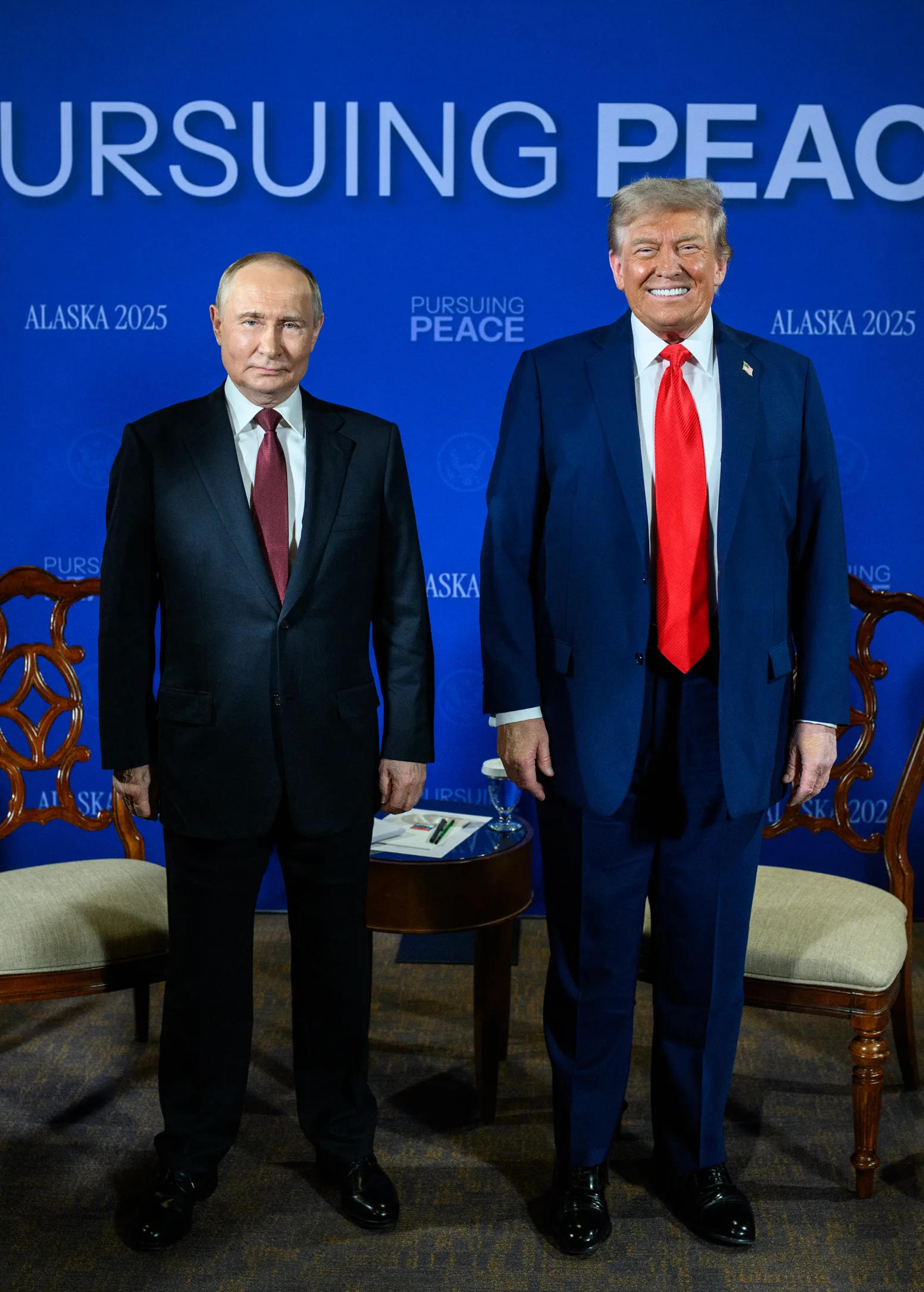
Photo: Donald Trump and Vladimir Putin during the 2025 US–Russia summit in Alaska. Official White House photo / Wikimedia Commons, public domain.



