
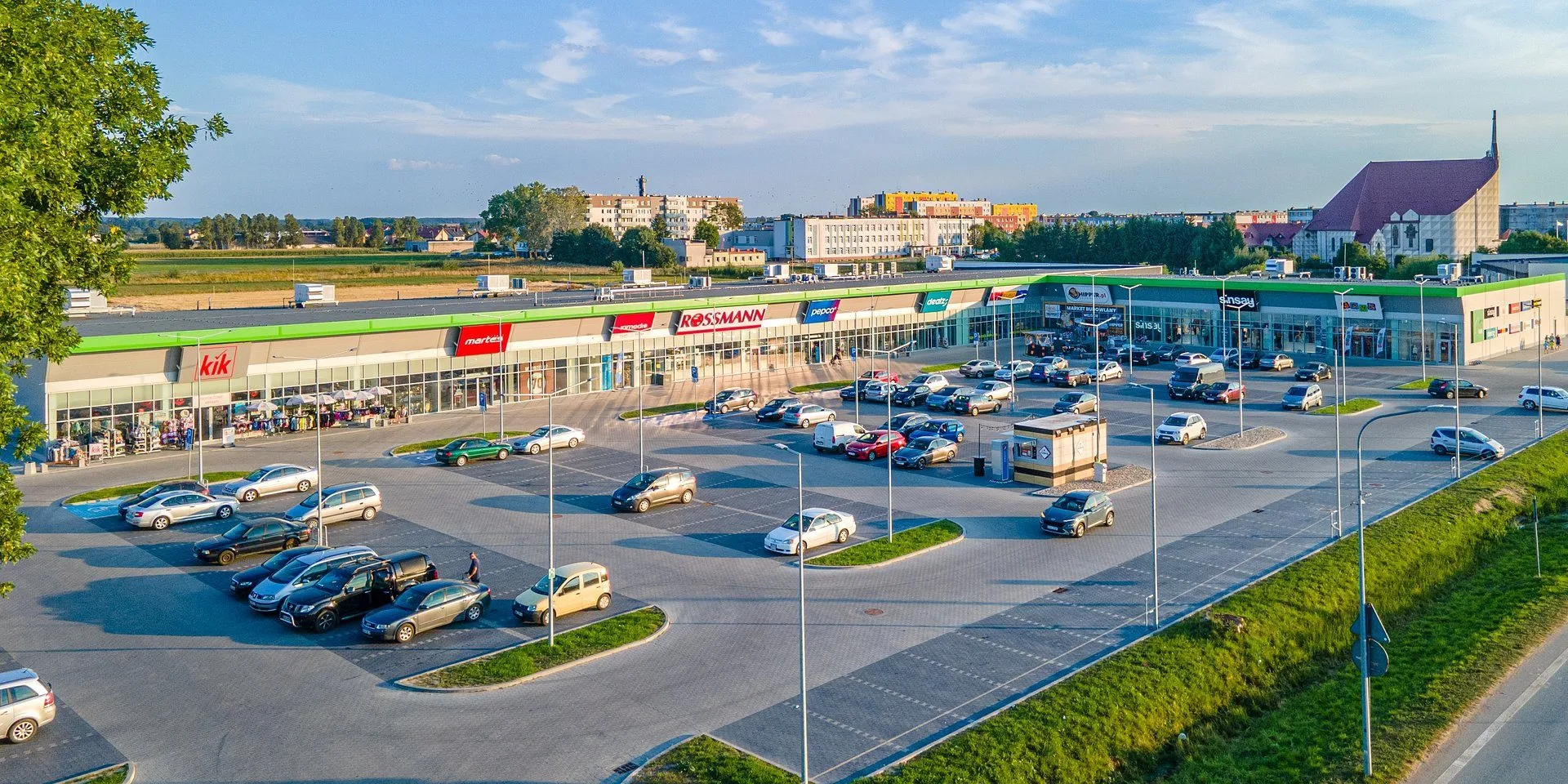


Retail parks are expanding rapidly across smaller Polish cities, where they are increasingly becoming local service hubs rather than simple collections of shops. Gyms, restaurants, medical and beauty services, entertainment and everyday services are taking a larger share of tenant mixes alongside traditional retail.
The format has proved particularly effective in towns with fewer than 50,000 residents. Customers value easy access, surface parking and the ability to combine several errands in one trip, while developers can often build at lower cost than in the largest metropolitan markets.
Smaller cities offer room for expansion
Large shopping centres are concentrated mainly in major urban areas. In smaller towns, retail parks can fill a gap between standalone supermarkets and traditional malls. Their simpler construction and operating model also allows investors to enter locations where a full-scale shopping centre would be difficult to justify.
For residents, the appeal is practical. A retail park located near a main road can bring fashion, groceries, household goods, fitness and services into one accessible place without requiring a trip to a regional capital.
The tenant mix is changing
The strongest change is visible in what retail parks actually contain. Discount and value retailers remain important anchors, but the format is broadening. Fitness clubs can generate visits outside normal shopping peaks, while restaurants and service businesses increase the number of reasons to return during the week.
This matters for landlords because a more diverse mix can reduce dependence on pure retail spending. A customer may come for a gym session, medical appointment or meal and make additional purchases during the same visit.
Convenience is the main competitive advantage
Retail parks generally offer direct access from car parks to individual units, shorter walking distances and less complicated layouts than enclosed shopping centres. In smaller cities, where car use is often central to everyday mobility, these features can be more important than architectural scale or entertainment-heavy mall concepts.
The format also fits the expansion strategies of chains that want national coverage. A standardised unit in a retail park can be easier to open and operate than a store in a large shopping centre with more complex lease structures and higher common-area costs.
Location quality still decides whether a project works
Rapid development creates its own risks. A smaller city has a limited catchment area, so several projects opening close together can quickly change the economics of a location. Developers need to assess population, purchasing power, road access, existing competition and the ability to attract a tenant mix that generates repeat visits.
For investors, lower land and construction costs do not eliminate leasing risk. The strongest parks are likely to be those that become part of residents’ weekly routines rather than destinations used only for occasional shopping.
Retail parks are becoming part of local infrastructure
The expansion of services changes how the format should be understood. In many smaller Polish cities, a retail park now functions partly as commercial infrastructure: a place to shop, eat, exercise and use everyday services.
That helps explain why development continues even as e-commerce grows and consumers remain cautious. The proposition is not simply more retail space. It is convenience concentrated in one location.
Source: market reporting published by CEO.com.pl.



