


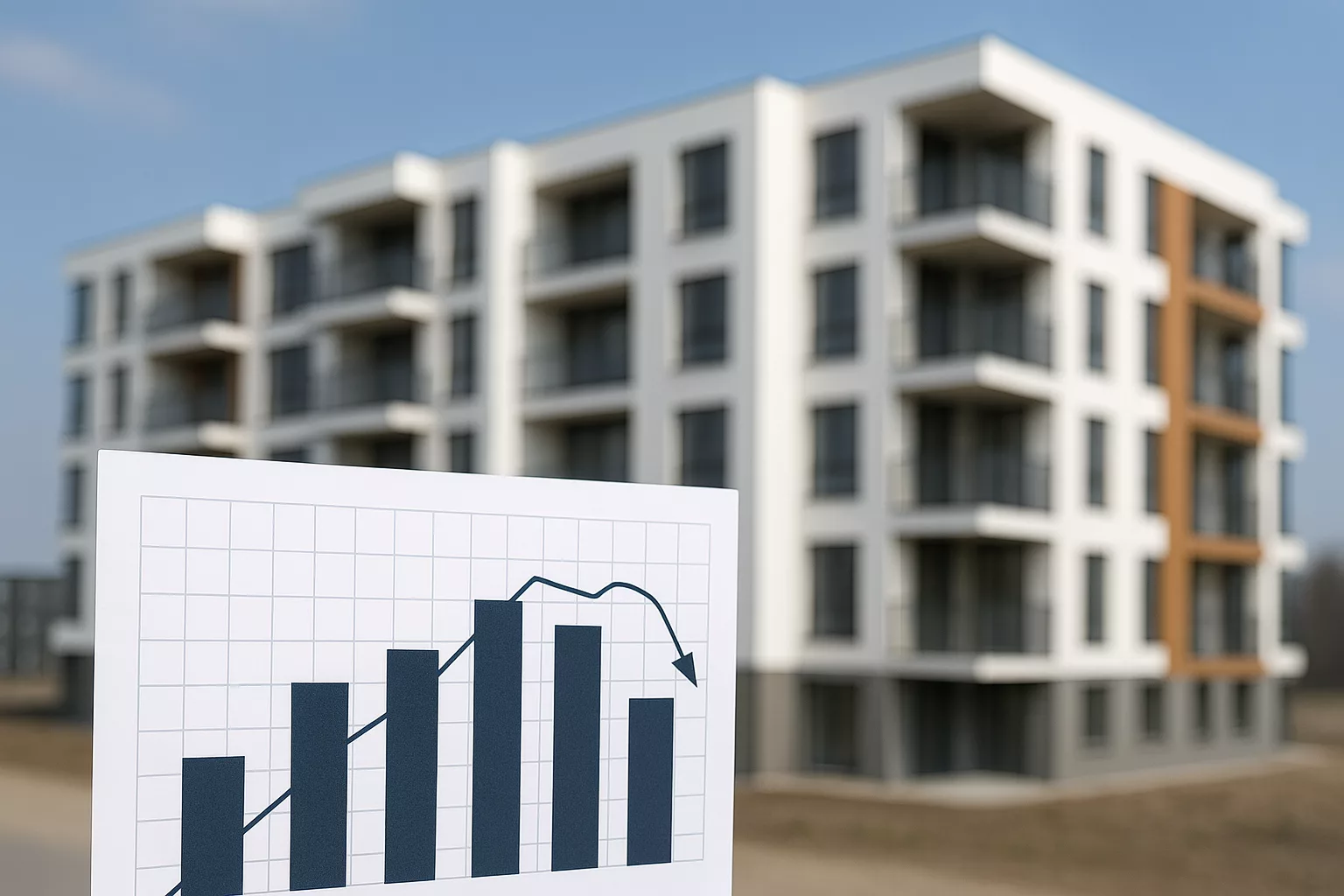
Reports of mass layoffs are becoming increasingly common in Poland. Unemployment has risen, and the government plans to raise the minimum wage by only 3% next year. Even though mortgage rates have fallen, the housing market recovery remains muted, held back by the deteriorating condition of the labor market.
Experts from BIG DATA RynekPierwotny.pl argue that the worsening job market is the main factor limiting demand in the Polish real estate sector.
Macroeconomic indicators look solid — but housing demand remains flat
At first glance, the macroeconomic data monitored by BIG DATA RynekPierwotny.pl seem positive for housing. For more than a year, Poland’s real GDP growth has exceeded 3%, placing the country among the EU’s top performers. Inflation has returned to the NBP target, and interest rates have fallen by 1 percentage point since May, reducing borrowing costs. As a result, mortgage affordability has improved by nearly 20% compared to a year ago.
However, home prices have stagnated for over a year, and even declined slightly on the secondary market. With nominal wages rising modestly, the real cost of housing is falling. Given this favorable macro backdrop — low inflation, rising real wages, and cheaper loans — one might expect housing sales to accelerate, especially after the government abandoned its mortgage subsidy programs, which had kept many buyers on the sidelines. Yet, pent-up demand has not materialized. Sales remain merely stable.
According to BIG DATA RynekPierwotny.pl, housing sales in Poland’s seven largest urban markets were about 13% higher in 2025 compared to the second half of 2024. Still, volumes remain well below those seen during the boom years of 2019 and 2021, and no clear upward trend has emerged. With developers releasing more new projects, the average time to sell existing inventory has lengthened — from 5.5 quarters to 6.5 quarters by August 2025.
Labor market weakness blocks a new housing growth cycle
Despite improving macro indicators, the job market is losing momentum, both in objective data and in consumer sentiment.
“Behavioral economics shows that subjective perceptions often outweigh hard statistics in shaping consumer decisions. Understandably, fears about personal finances, job stability, or the broader economic and geopolitical environment can delay major life choices — such as buying a home, especially on credit,” explains Jan Dziekoński, Head of Market Insights at RynekPierwotny.pl.
Since early 2024, surveys by the Central Statistical Office (GUS) have shown a decline in public confidence and rising concerns about unemployment. While 2025 brought a partial stabilization, pessimism still dominates. Not coincidentally, this period has also seen weaker demand in the housing market — mirrored by GUS indicators on major household purchases, which have stagnated since the start of the year.
As a result, housing sales growth remains sluggish. However, there may be a silver lining. Despite their caution, Polish consumers are benefiting from low inflation and rising real incomes. For over a year, they have reported improved ability to save, building financial reserves that could eventually reignite housing demand once confidence in the job market returns.
Unemployment remains low — but is rising
Are job insecurity fears justified? Partly, yes. Official unemployment rates in Poland remain among the lowest in EU history, but trends are clearly worsening. Registered unemployment has been rising for several months, reaching 5.6% in September 2025, while the more reliable Labor Force Survey (BAEL) measure stood at 2.8% in Q2 2025.
“These are still low levels, but they’re noticeably higher than in previous years,” says Dziekoński. “The rise isn’t random — other indicators point to weaker labor demand. The number of job postings is falling, employment levels are declining, and both private and public sectors continue to report group layoffs. The number of long-term unemployed and those under 25 is also growing. Objectively, the market looks fine by historical standards, but media headlines and social discussions amplify anxiety — and that’s often enough to delay home-buying decisions.”
Whether unemployment will continue to rise depends on multiple forces. On one side, construction, IT, and professional services sectors are struggling, reducing labor demand. On the other, demographics are tightening supply: every year, around 100,000 more people retire than enter the workforce. Migration trends — whether positive or negative — could also shift the balance.
Slower wage growth: a problem, but also a potential relief for housing
The softening labor market is reflected not only in employment but also in wage dynamics. According to BIG DATA RynekPierwotny.pl, nominal wage growth — which had been running in double digits since 2022 — has now slowed to single digits. Since early 2025, average wages have grown below 10%, and in August the pace dropped to just 7%.
A key factor influencing wage growth is the minimum wage, alongside inflation and labor market conditions. In September 2025, the Polish government announced that the minimum wage will increase by only 140 PLN next year, reaching 4,806 PLN — a rise of just 3%, the lowest in 20 years. According to NBP’s July forecast, average wage growth is expected to slow further to 5–6% in the coming years.
While this trend won’t please employees or mortgage borrowers, it may have positive side effects.
“Slower wage growth means lower inflation, especially in services, which could support further interest rate cuts and cheaper credit,” explains Dziekoński. “The October rate cut by the Monetary Policy Council — somewhat unexpected — may have been partly motivated by labor market weakness. Lower wage pressure also reduces the cost of labor and construction materials. GUS data show that the ‘construction cost inflation’ index has already fallen to below 3%. With material prices in deflation, overall construction costs could stabilize or even fall next year. Finally, weaker demand pressure may keep rental price growth subdued.”
Outlook
The Polish economy remains fundamentally healthy, but the labor market has become the key bottleneck for a full recovery in housing demand. Rising unemployment fears, slower wage growth, and subdued consumer confidence are keeping buyers on the sidelines — even as credit conditions improve.
If these concerns ease in 2026, the savings accumulated by cautious households could quickly flow back into the housing market, setting the stage for a renewed cycle of growth.
Source: CEO.com.pl – “Rynek nieruchomości spowalnia mimo tanich kredytów. Winny słabszy rynek pracy”