
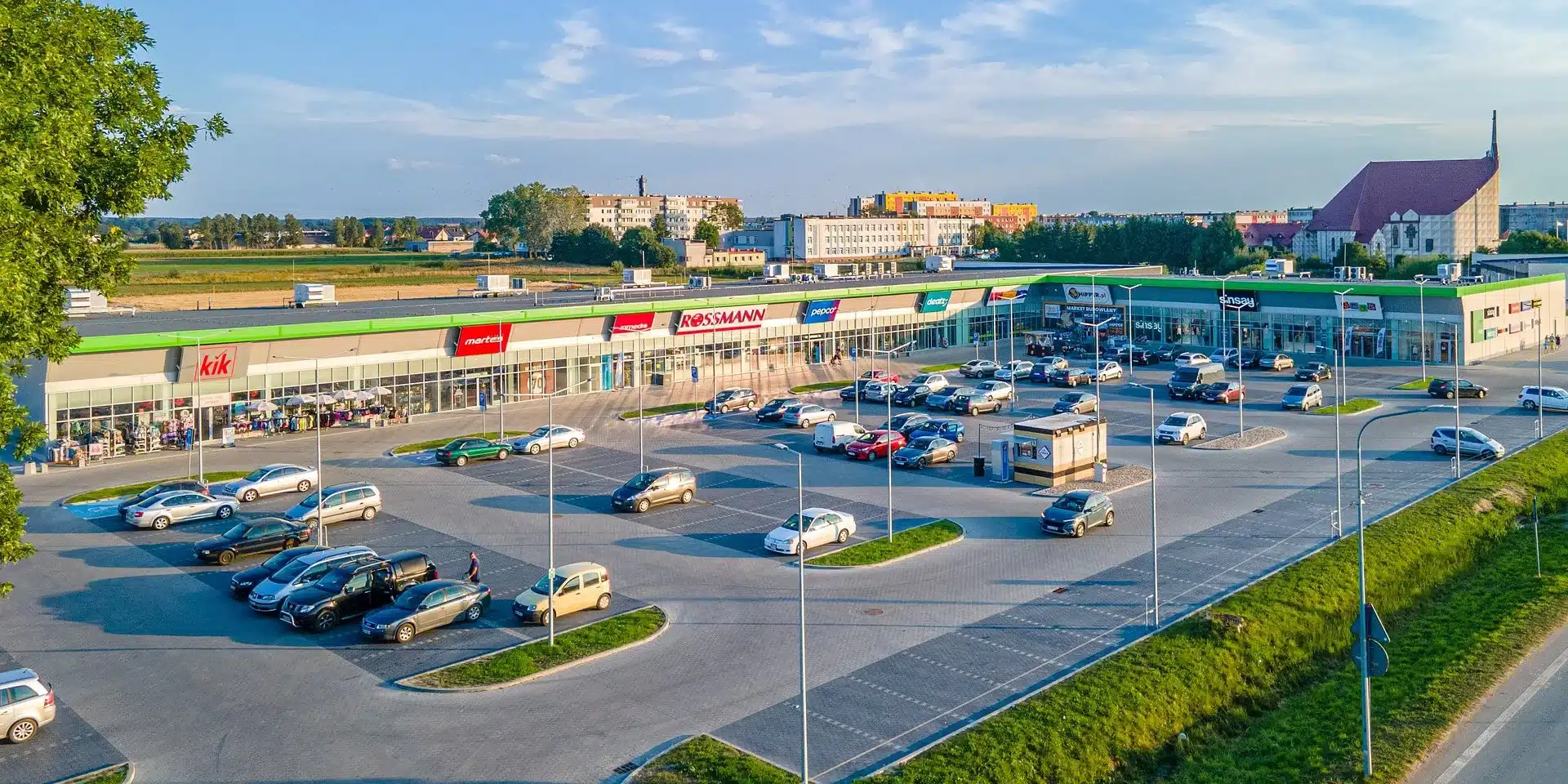


The international advisory firm Cushman & Wakefield has released its latest report on Poland’s retail property market. Unlike the office and warehouse sectors, developer activity in retail remains exceptionally strong. The volume of retail parks under construction is now the highest in history, with developers increasingly targeting smaller towns. This indicates that the market is gradually reaching saturation in the retail park format. Meanwhile, retail sales and shopping center turnovers continued to rise during the summer months, reflecting resilient consumer spending.
SUPPLY: RETAIL PARKS LEAD NEW DEVELOPMENTS
Third-quarter data show a stable trend in new retail supply, with approximately 90,000 sq m of space delivered to the market — nearly identical to the previous quarter. Most new openings were retail parks, bringing Poland’s total modern retail stock to just over 17 million sq m, said Ewa Derlatka-Chilewicz, Head of Research Poland at Cushman & Wakefield.
The largest newly opened retail property was S1 Włocławek, developed by Saller, offering 17,000 sq m on the site of a former Tesco store. Other projects exceeding 10,000 sq m included M Park Ciechanów and Przystanek Karkonosze, located in the village of Miłków near Karpacz. Altogether, seven new retail parks were completed in Q3, while two existing sites in Iława and Wrocław underwent extensions.
Additionally, two standalone Leroy Merlin DIY stores opened in Chojnice and Dzierżoniów. Notably, no shopping centers were opened or closed during the quarter.
Developer activity remains on an upward trajectory, reaching new records each quarter. By the end of September, 618,000 sq m of retail space was under construction, marking the highest level since 2018. Retail parks account for 480,000 sq m of this pipeline — the largest volume on record. Around half of this space is located in towns with fewer than 50,000 residents, outside the 30 largest metropolitan areas, underlining the rising importance of smaller regional retail markets, adds Derlatka-Chilewicz.
DEMAND: SEVEN NEW RETAIL BRANDS ENTER THE MARKET
Several new retail chains, previously unavailable in Poland as brick-and-mortar stores, launched their first physical outlets in Q3 and plan further expansion. There were seven brand debuts during the quarter:
- Carhartt WIP (U.S. fashion brand, first store on Plac Zbawiciela in Warsaw)
- MiniSo (accessories and toys, Złote Tarasy)
- DRM-LND (personalized accessories, Złote Tarasy)
- ZAG Bijoux (jewelry, Złote Tarasy)
- Ocean and One By One (Ukrainian fashion brands, in Warsaw and Poznań respectively)
- Almarah Perfumes (fragrance retailer, Galeria Młociny)
RETAIL SALES: CONSUMERS SHIFT FOCUS TO DURABLE GOODS
After a strong second quarter, retail sales continued to grow in Q3, though at a slower pace than the April peak.
In July, retail sales in constant prices rose by 4.8% year-on-year, and in August by 3.1%. Categories crucial to shopping centers performed particularly well, such as “Textiles, clothing, and footwear” (+18.9% y/y) and “Furniture, electronics, and household appliances” (+13.9% y/y). After declines in 2023–2024, the furniture and electronics segment is now experiencing a clear rebound.
This recovery may stem from high consumer confidence compared to other European countries. According to Eurostat, Poland remains among the EU leaders in this regard. After fluctuations in June (+2.8) and July (–2.5), the consumer confidence index stabilized at –1.0 in September, versus the EU average of –14.3, notes Ewelina Staruch, Senior Analyst at Cushman & Wakefield.
Declines in August were limited to three categories: “Other,” “Food, beverages, and tobacco,” and “Press, books, and specialized stores.” In the largest category — “Food, beverages, and tobacco” — sales fell by 3.4% y/y. Stable employment and moderating inflation are expected to support further private consumption growth in Q4.
FOOTFALL AND SALES: STRONGEST PERFORMANCE IN SEPTEMBER
Shopping centers attracted an average of 425,000 visitors per property in Q3. August was the strongest month, with 440,000 visitors per center on average, though this was 1.4% lower year-on-year, adds Derlatka-Chilewicz.
In July, footfall averaged 435,000, nearly identical to July 2024. September was the only month to record growth (+3.3% y/y), though the visitor count dropped to around 400,000 due to the post-summer slowdown.
In terms of sales performance, tenants’ average revenues rose by just over 3% in Q3.
- July: average turnover reached PLN 1,130 net per sq m, up 3.4% y/y.
- August: turnover averaged PLN 1,145 per sq m, up 3.2% y/y, explains Staruch.
The strongest year-to-date (January–August 2025) growth was recorded in services (+8%) and food & entertainment (+6%). However, rising operational costs in the F&B sector continue to pressure profitability despite higher turnover.
RENTS: PRIME PROPERTIES RETAIN GROWTH POTENTIAL
Average rents in prime retail assets continued to grow year-on-year across all three formats — shopping centers, retail parks, and high streets. These increases exceeded standard inflation-based indexation, signaling strong demand for flagship locations and limited availability of premium retail space, says Paulina Bauer, Head of Retail Asset Services Poland at Cushman & Wakefield.
Retail parks recorded the highest rent growth, up 12.5% year-on-year, with further quarterly increases. Shopping centers and high streets also saw solid annual growth of 7–10%, with stable quarter-to-quarter rates.



