
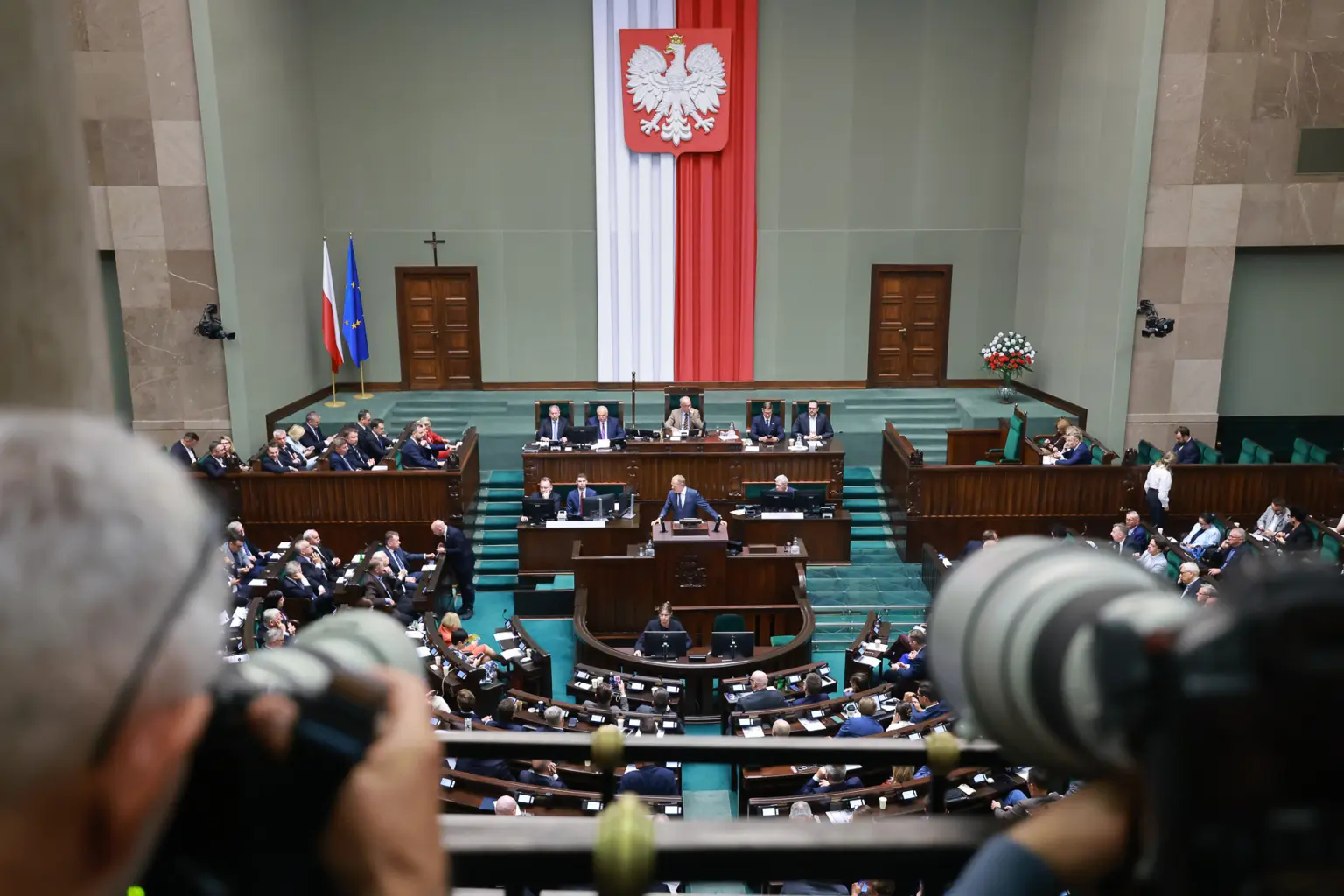


Poland’s Sejm has failed to override President Karol Nawrocki’s veto of legislation regulating the crypto-assets market. A total of 241 MPs voted to pass the bill again, 198 voted against and three abstained. The required three-fifths majority was 266 votes. Before the vote, Prime Minister Donald Tusk presented excerpts from testimony gathered in the Zondacrypto investigation, arguing that the case concerns not only investor protection but also national security and the integrity of public institutions.
The vote marked the third unsuccessful attempt by parliament to overcome a presidential veto of legislation intended to bring Poland’s crypto-assets market under a more comprehensive supervisory framework. Law and Justice (PiS), Rozwój Plus and Confederation MPs were among those voting against overriding the veto.
Prime Minister Donald Tusk argued that the lack of a full domestic regulatory framework makes it harder for Polish authorities to monitor financial flows that may be used for criminal activity, money laundering or sabotage. He also linked the legislative dispute to the ongoing investigation into Zondacrypto and alleged attempts by people associated with the crypto exchange to build political influence.
Prime minister quotes testimony from the investigation
During his address to the Sejm, the prime minister cited excerpts from the testimony of a key witness in the case. According to the account quoted in parliament, people connected to Zondacrypto allegedly sought political assistance in relation to investigations and contacts with state institutions.
One of the passages cited by Prime Minister Donald Tusk referred to former justice minister Zbigniew Ziobro. According to the witness account, Ziobro was allegedly informed about ongoing proceedings and was said to have indicated that he could intervene if he returned to the Ministry of Justice.
The testimony quoted by the prime minister also referred to money that was allegedly to be transferred through a foundation linked to the Sovereign Poland political milieu. According to the witness, a total amount of PLN 2 million had been discussed, with part of the money already transferred.
These statements form part of testimony in an ongoing investigation. They are not a final court finding and do not determine the criminal liability of any person mentioned in the proceedings.
Zbigniew Ziobro has previously acknowledged that the Instytut Polski Suwerennej Foundation received PLN 450,000 from a law firm owned by Przemysław Kral, the president of Zondacrypto. The former justice minister has denied that the payment was connected to prosecutorial decisions or political favours.
Alleged promise of a presidential pardon
Another section of the testimony presented by the prime minister concerned an alleged promise of a future presidential pardon. According to the account read out in the Sejm, one person was said to have assured the witness that a pardon could be arranged if Karol Nawrocki became president and the witness was later convicted.
The witness allegedly linked that assurance to funding for political and public events, including activities in the United States. Prime Minister Donald Tusk stressed that he was presenting only part of the material gathered by investigators.
The latest disclosures add another layer to the broader political dispute over Zondacrypto, which has already triggered exchanges of accusations between the government, the presidential camp and opposition politicians.
Opposition rejects the government’s accusations
Representatives of the opposition rejected the prime minister’s interpretation of the case and accused the government of selectively using investigative material for political purposes.
Presidential chief of staff Zbigniew Bogucki called for the disclosure of more information about proceedings linked to Zondacrypto, including decisions to discontinue investigations. He argued that the public should be given a fuller picture of how the cases were handled under different governments.
PiS leader Jarosław Kaczyński said he had no involvement in matters concerning the cryptocurrency market. Referring to money received by a foundation associated with Zbigniew Ziobro, however, he said accepting the funds had been a mistake.
The dispute also concerns the substance of the legislation itself. President Karol Nawrocki’s office maintains that the president does not oppose regulating crypto-assets as such, but objects to the model proposed by the parliamentary majority. The president has also put forward his own legislative proposal for the sector.
Government points to security risks
The government says tighter supervision is necessary not only to protect investors but also to strengthen the state’s ability to track suspicious transactions. Prime Minister Donald Tusk said cryptocurrencies are used in criminal networks and can also facilitate the financing of sabotage and hybrid operations.
He pointed in particular to threats linked to Russian activities and said the absence of adequate rules complicates the work of the Internal Security Agency and the Foreign Intelligence Agency when tracing crypto-based financial flows.
The Sejm nevertheless fell 25 votes short of the majority required to override the veto. As a result, President Karol Nawrocki’s decision remains in force and the disputed legislation will not enter into effect in its current form.



