
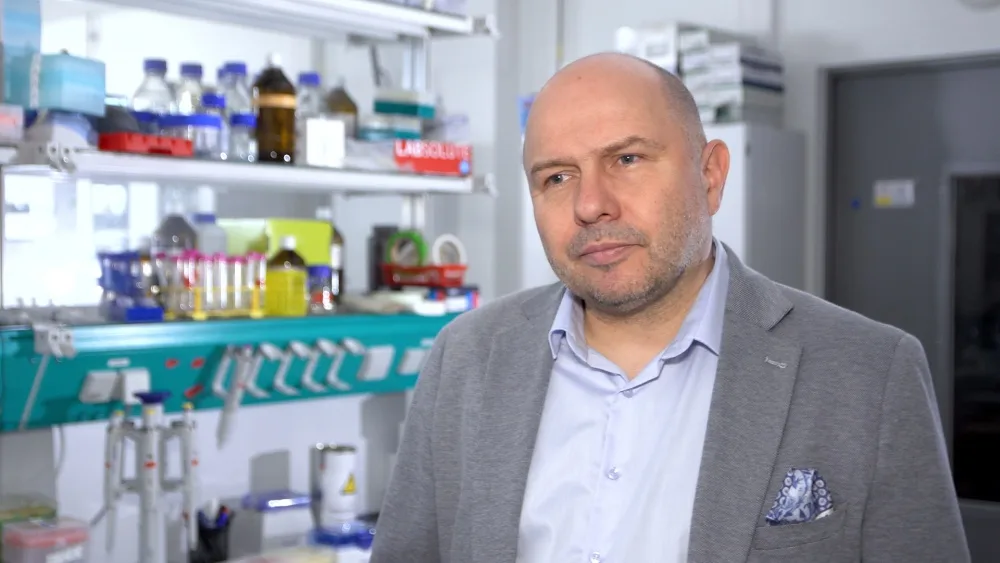


For nearly 30 years, mRNA technology has been developed with therapeutic applications in mind. The breakthrough came with the creation of the first two COVID-19 vaccines, which, according to Prof. Jacek Jemielity, were possible in such a short time thanks to decades of prior research. Yet, the therapeutic potential of this technology is much broader—intensive work is underway on cancer vaccines, as well as on treatments for metabolic disorders, rare diseases, and applications in regenerative medicine.
“mRNA technology has been under development for nearly three decades, but the real breakthrough was during the pandemic when two effective COVID-19 vaccines were created in record time. This was possible because we already knew so much about the technology—how to use it and how to apply it effectively. As a result, two companies independently produced successful vaccines that changed the course of the pandemic,” said Prof. Jacek Jemielity from the Centre of New Technologies at the University of Warsaw.
Cancer Vaccines and RNA Stability
The therapeutic potential of RNA extends far beyond antiviral use. For many years, research has focused on developing cancer vaccines, considered one of the most promising applications of this technology.
“Cancers are a far more complex adversary because they develop mechanisms to evade immune responses. However, progress has been made in this field. Our team contributed by developing an invention that improves RNA stability, which has been used by a major pharmaceutical company in several clinical trials of cancer vaccines,” Prof. Jemielity explained.
The research team led by Prof. Jemielity and Dr. Joanna Kowalska, in collaboration with scientists from the Medical University of Warsaw and spin-off ExploRNA Therapeutics, developed a new mRNA modification that significantly boosts protein production at lower therapeutic doses. Their modified mRNA molecule (AvantCap) was shown to be up to six times more efficient in certain systems, and under specific conditions, even 100 times more effective.
One of the most promising approaches is personalized therapy, where the vaccine is tailored to a patient’s specific tumor mutations. “This makes cancer vaccines more effective, though none have yet been approved for general use,” Jemielity noted.
Broader Applications: Metabolic and Genetic Diseases
Beyond vaccines, mRNA is used in protein supplementation therapy—treating diseases caused by missing or dysfunctional proteins. In such cases, RNA must ensure long-term protein production, ideally throughout a patient’s lifetime. Examples include metabolic diseases such as phenylketonuria and cystic fibrosis, as well as various muscular dystrophies.
mRNA also plays a role in regenerative and cellular medicine and in genome editing technologies such as CRISPR-Cas9. “In these systems, one component is a bacterial protein that must be delivered into the body. The most effective way to deliver it is through mRNA,” explained Jemielity.
Extending RNA Lifespan with Circular Molecules
To unlock the full potential of mRNA, scientists must extend the duration of RNA-based protein production. Researchers at the University of Warsaw, in collaboration with WUM and MIBMiK, recently pioneered a chemical method for producing circular mRNA. Unlike linear RNA, circular RNA has no ends—its most vulnerable points of degradation. Closing RNA into a loop prolongs its lifespan and extends protein production. This innovation may prove useful in treating rare genetic diseases, including cystic fibrosis.
The Challenge of Delivery
Another critical challenge is delivering mRNA to specific tissues and cells. Currently, lipid nanoparticles (LNPs) are the standard, working effectively for the liver but less so for other tissues. Research is underway to develop new delivery systems to expand the technology’s reach.
Fighting Disinformation
Prof. Jemielity also stressed that the spread of misinformation is one of the greatest obstacles to progress.
“Misinformation on the internet spreads at the speed of light. Fighting it is extremely difficult because it requires time and expertise. Sadly, disinformation also affects people who make decisions about science funding and development priorities. A sobering example is the United States, where projects related to mRNA vaccines are now being limited or cut back due to such pressures,” he warned.



