

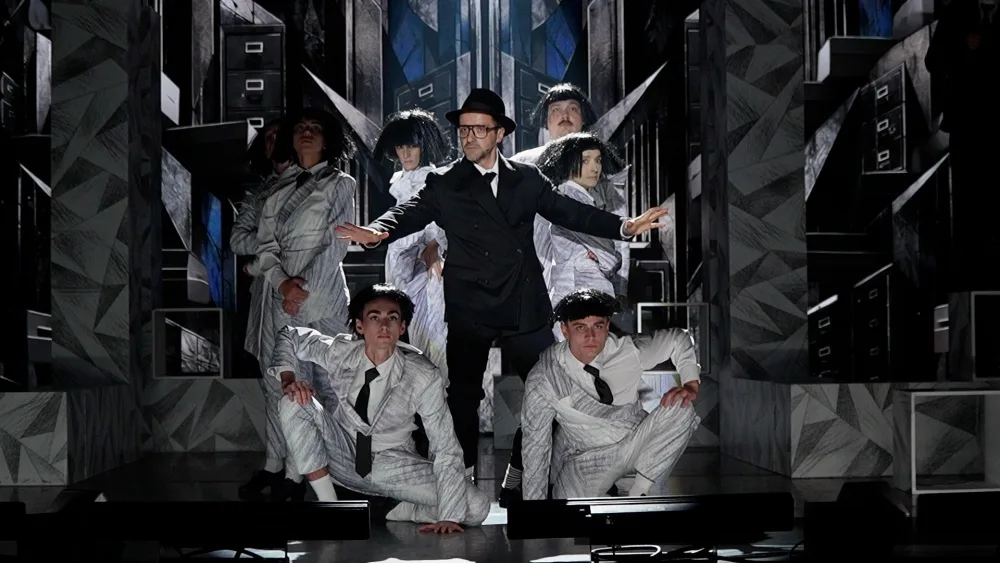
Master Twardowski, the Water Spirit of Płock and the Black Beast of Ciechanów are among the mythical characters brought together in a new family musical. Where Is Róża?, created by Warsaw Chamber Opera, celebrates 500 years since Mazovia was incorporated into the Kingdom of Poland. Inspired by a book by Marta Honorata Milewska, the production mixes comedy, a mystery and a fairy tale.
The story begins when officials are dispatched to check whether characters from Mazovian legends are still active. Their seemingly routine inspection takes an unexpected turn when Róża of Wyszków goes missing. The search provides the central plot of the musical.
A fantasy bureaucracy and a missing heroine
In the fictional Bureau for Standardisation and Registration of Fairy Tales and Legends, every supernatural being has its own file and is subjected to periodic checks. Two officials with very different personalities set out on the investigation: Witold Właściwy, who relies on rules and documentation, and Konrad Cudny, who believes every legend deserves to be heard.
Their journey takes them through Węgrów, Płock, Ciechanów and Wyszków, where they encounter creatures and characters who do not always behave as the official records suggest.
Alicja Węgorzewska-Whiskerd, director of Warsaw Chamber Opera, told Newseria that the project grew out of her fascination with Milewska’s book and the diversity of Mazovian folklore. She wanted to combine the various stories and locations into one musical narrative rather than offer a conventional anniversary production.
Music, costumes and regional history
Jerzy Wołosiuk, who previously created the musical story Lost Carols, wrote the music and libretto and also conducts the production. Jerzy Jan Połoński directs, Katarzyna Gabrat-Szymańska designed the stage setting, and Marcin Łobacz created the costumes. Węgorzewska-Whiskerd praised Łobacz’s previous award-winning work with the company.
The historical anniversary commemorates events in 1526, when Mazovia was incorporated into the Polish kingdom after the deaths of the final Mazovian dukes, Stanisław and Janusz III. Museums and cultural institutions across the region are marking the anniversary. The Mazovian Museum in Płock, for example, organised an exhibition focusing on the region’s place in the Polish Crown, including medieval manuscripts and objects associated with the Mazovian Piast dynasty.
Eighteen stories from across Mazovia
Milewska’s book, Mazovia: A Book of Legends and Mysteries, collects 18 stories involving princes, knights, dragons, supernatural beings and local communities. Drawing on places including Kurpie, Płock, Radom and Siedlce, it combines legends with historical details and ideas for exploring the region.
The author told Newseria that she wanted to move beyond the best-known tales and represent Mazovia’s varied cultural heritage. The collection includes stories associated with Jewish and Roma communities as well as legends about historical rulers and cities. Local historians and regional enthusiasts have helped keep many such traditions alive.
Milewska welcomed the transformation of her stories into a colourful theatrical production and noted that the book has also inspired performances and readings in schools and community cultural centres.
Warsaw Chamber Opera describes Where Is Róża? as a musical for families. Through its fictional characters and playful investigation, the production aims to introduce audiences to the history and legends of Mazovia while highlighting the 500th anniversary of the region’s incorporation into Poland.
Source: Newseria; interviews with Alicja Węgorzewska-Whiskerd and Marta Honorata Milewska.