


Freight volumes are increasing, but the more important change in 2026 is timing. Companies are sending goods earlier and using a broader mix of transport modes as geopolitical disruption and regulatory changes make supply chains less predictable. The result is visible in ocean and air freight, rail traffic and the warehouse market.
Ocean freight peaked earlier than usual
For years, the traditional ocean-freight peak came in late July and August. That pattern has shifted. Volumes started rising in June last year, while this year the first signs of the peak appeared by the end of May.
The season is becoming flatter because businesses are bringing shipments forward instead of concentrating them in one narrow window. The change reflects a deliberate effort to reduce exposure to disruption.
At the start of the year, there had been expectations that regular Red Sea services might return and restore a roughly 45-day route from China to Europe rather than the approximately 60-day voyage around Africa. Renewed tension in the Middle East pushed that prospect further away and raised freight costs through higher fuel prices and continued route uncertainty.
Schedule reliability has also weakened. Only around 60% of sailings are currently arriving in line with published schedules, according to the market observations cited in the Polish article. Operational disruption at Chinese ports, including stronger-than-usual August typhoons, and periodic labour action at German and Dutch ports have added to delays.
Polish seaports are meanwhile attracting more interest as cargo volumes increase and importers look for alternatives to other European hubs.
Rail is benefiting from diversification away from ocean routes
China–Europe rail traffic had already increased in the first half of the year. In the first quarter, the number of trains on the corridor rose 29% year on year.
The rail peak traditionally comes later, around October and November. But experience from ocean freight suggests demand could move forward here as well, particularly for companies that use rail as a hedge against uncertainty at sea.
Air-freight routes have also shifted
Air cargo was disrupted in spring by restrictions and, at times, closures of airspace over the Persian Gulf. Doha and Dubai — major hubs linking Europe with Southeast Asia and Australia — temporarily lost part of their role to alternative routes, including through Turkey.
Gulf hubs are now operating close to normal capacity again, but freight rates remain higher because of fuel costs and airline surcharges, while the regional situation remains unstable.
Companies are therefore moving some urgent shipments into air freight earlier than they traditionally would, flattening the peak season there as well.
Customs changes are altering the economics of low-value e-commerce
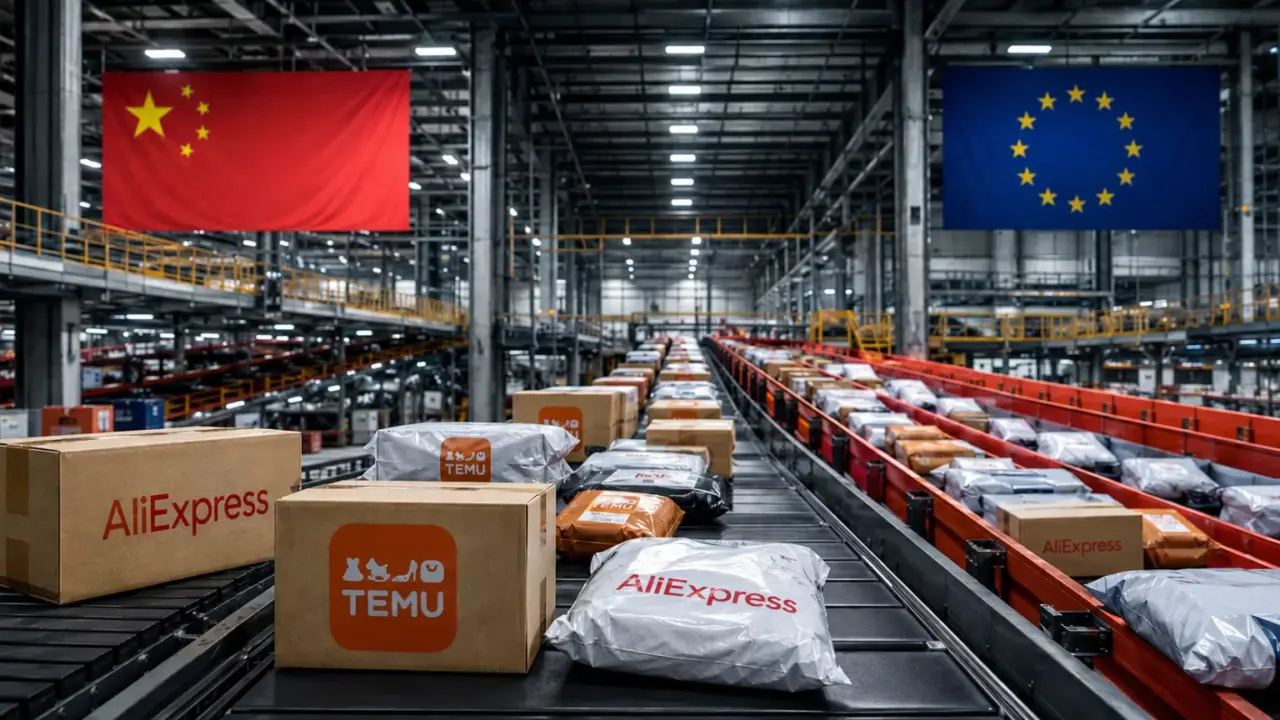
The EU’s July customs changes have also affected the mix of air cargo. The removal of the duty exemption for low-value consignments and the introduction of a temporary €3 charge per goods category made direct shipment of individual parcels less attractive.
Estimated imports of low-value consignments fell by more than 30%, while air transport of that category was down by close to 33% year on year.
That does not necessarily mean Chinese e-commerce is withdrawing from Europe. Instead, the economics increasingly favour moving larger consolidated volumes by sea or rail, holding inventory within the EU and fulfilling individual orders locally.
AI infrastructure is creating a new source of air-freight demand
At the same time, another fast-growing source of demand is emerging: hardware for artificial intelligence and data centers.
Servers, GPUs, network equipment and cooling systems are high-value products tied closely to construction and commissioning schedules. Technology companies are therefore more willing to use air freight despite higher rates.
This demand partly offsets weaker low-value e-commerce volumes and adds competition for cargo capacity during peak periods.
Inventory is moving closer to European customers
Warehouse demand is being supported by more than e-commerce. Companies in multiple sectors are importing earlier and holding larger buffers inside Europe to improve resilience.
In Poland, warehouse demand is at its highest since 2022. E-commerce companies alone leased more than 800,000 sq m in the first half of the year, while Chinese tenants are among the most active occupiers. Similar trends are visible elsewhere in Central and Eastern Europe, particularly in the Czech Republic and Romania.
Nearshoring is usually discussed as a relocation of production. In this case, it is storage that is moving. More stock held within the EU also increases demand for customs services, road distribution, ports and rail terminals.
Warehouse clients are also seeking more value-added services such as co-packing, gift-set assembly and preparation of retail display stands, particularly in sectors such as cosmetics and electronics.
Road transport will feel the effect closer to the consumer peak
Higher volumes across ocean, rail and air transport, combined with larger warehouse inventories, are expected to feed into road transport in the weeks ahead. That applies both to domestic distribution and international trucking.
Last-mile demand should rise as well, including services such as delivery into the home and installation of products.
Why are more goods moving towards Europe?
Part of the explanation is economic growth. Central and Eastern Europe has continued to outperform much of the continent, with Poland among the stronger economies. Consumer demand and investment translate directly into the volume of goods that retailers need to bring in ahead of the autumn selling season.
Trade flows are also being redirected. US imports from China fell by almost 30% in 2025, while China’s total exports still grew. Part of the displaced volume moved towards Europe, Southeast Asia, Latin America and Africa. EU goods imports from China rose 6.4%.
Fuel prices remain an important uncertainty
The Middle East remains one of the biggest cost risks for logistics. Fuel-price volatility affects almost every transport mode and can eventually feed into the prices of imported goods.
If energy costs remain elevated, freight rates could rise further and add inflationary pressure just as companies enter the strongest consumer season.
Flexibility is becoming the central logistics advantage
The 2026 season shows that there is no longer one universal peak-season strategy. Goods are moving earlier, more shipments are switching between transport modes and a larger share of inventory is being positioned inside Europe before final demand materialises.
That makes advance planning more important. Warehouse space, customs capacity and transport slots can all tighten before the traditional peak itself. Operators that can combine multiple modes, provide customs services and secure regional warehousing are therefore becoming more valuable to importers trying to manage disruption.