

The European Parliament’s Transport and Tourism Committee is working on a passenger package proposed by the European Commission in May. One of its central ideas is a single rail ticket that would allow travellers to combine services from different operators in one transaction. Polish MEPs say the proposal could make connections easier and strengthen passenger protection, but they also question whether smaller regional carriers can meet the new administrative and financial obligations.
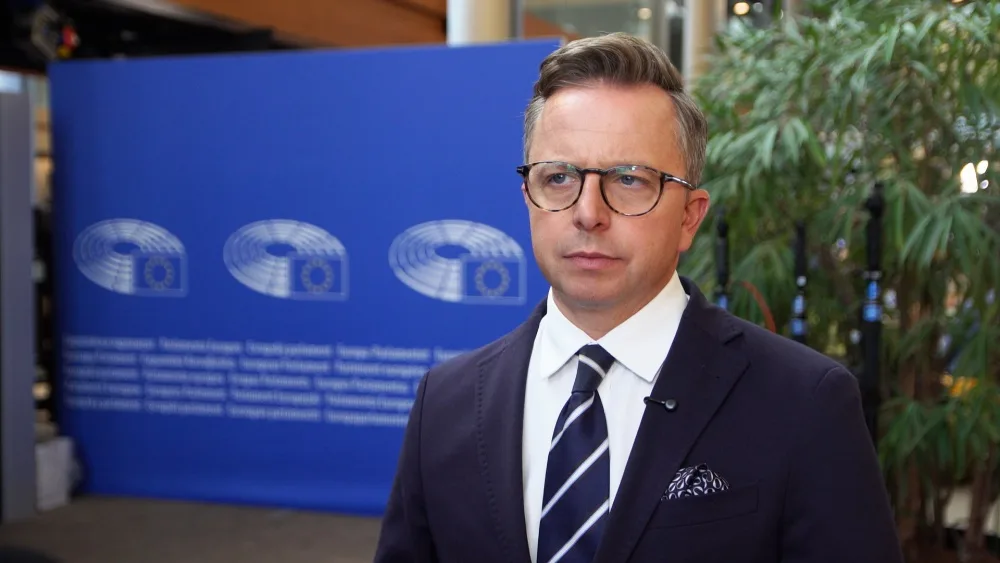
“The European Union wants to introduce a single rail ticket in the coming months, so that we can use an application on our phones to book one combined ticket valid across Europe,” Dariusz Joński, a Civic Coalition MEP belonging to the European People’s Party, told Newseria.
One purchase for journeys with several operators
Under the Commission’s proposal, passengers would be able to find, compare and buy services from different rail operators as part of a single ticket, purchased in one transaction on a platform of their choice.
Joński said the aim is to simplify booking as well as travel itself. A passenger travelling from Łódź to Paris via Berlin should be able to arrange the whole journey before departure, rather than organise separate tickets for each leg. “We want passengers to feel that, alongside fast rail, there is a fast booking process,” he said.
The proposed package would also strengthen protection for travellers who miss connections during a journey involving several operators. Assistance, rerouting, refunds and compensation would be covered by the new framework.
“In principle, the single rail ticket responds to passengers’ needs in the same way as air travel. We buy one ticket on one website instead of searching ten websites,” said Elżbieta Łukacijewska, another Civic Coalition and EPP MEP. She explained that travellers could be entitled to compensation, accommodation or a refund when an operator failed to get them to a connection on time.
Booking difficulties discourage international rail travel
A 2025 Eurobarometer survey found that 76% of Europeans use online ticket-booking services. However, 25% of respondents reported difficulties booking rail journeys involving multiple operators, while 43% had not booked such journeys at all.
Joński argued that the biggest challenge is not developing an application, but establishing settlements between railway companies across the EU. He also emphasised the importance of punctuality: reliable connections are necessary if passengers are to trust a combined journey.
“We want compensation not so that rail companies pay it, but so that they have an incentive to arrive on time, because only then does a connecting system make sense,” he said. He pointed to substantial delays in some neighbouring countries as an obstacle to seamless travel.
Regional operators face questions over costs
The Commission also proposes new duties for ticketing platforms and operators to ensure fair access to ticket sales and neutral presentation of travel offers.
“If we apply the burdens envisaged by the Commission to small companies, they may simply be unable to bear the weight and the costs. There is a question about whether they are administratively prepared,” Łukacijewska said.
She added that regional operators often serve only one area but form an important part of longer journeys, taking passengers to connections with long-distance services. While she supports putting passengers at the centre of the system, she wants to see the final rules and how Poland’s government and railway companies respond.
Joński acknowledged concerns about sharing commercial information, but argued that they can be overcome. He said a simpler booking experience and competitive pricing could encourage travellers to choose trains over cars or planes, benefiting operators through higher passenger numbers.
The Commission says railway companies would also gain the ability to sell tickets through major national platforms owned by incumbent operators with significant market positions. The changes are intended to make newer operators easier to find and their services easier to combine with those of other companies.
According to Joński, political groups in the European Parliament broadly support the idea of a common rail ticket and a simpler booking system.
Polish railways carried almost 270 million passengers in January–July
Figures from Poland’s Office of Rail Transport show that monthly passenger-service punctuality ranged from 84% to 92% in January–June 2026. Between January and July, Polish trains carried 269.87 million passengers.
Polregio accounted for the largest share of passengers, at 21.95%, followed by PKP Intercity with 20.06% and Koleje Mazowieckie with 16.44%.
Source: Newseria. English adaptation of the original report.