
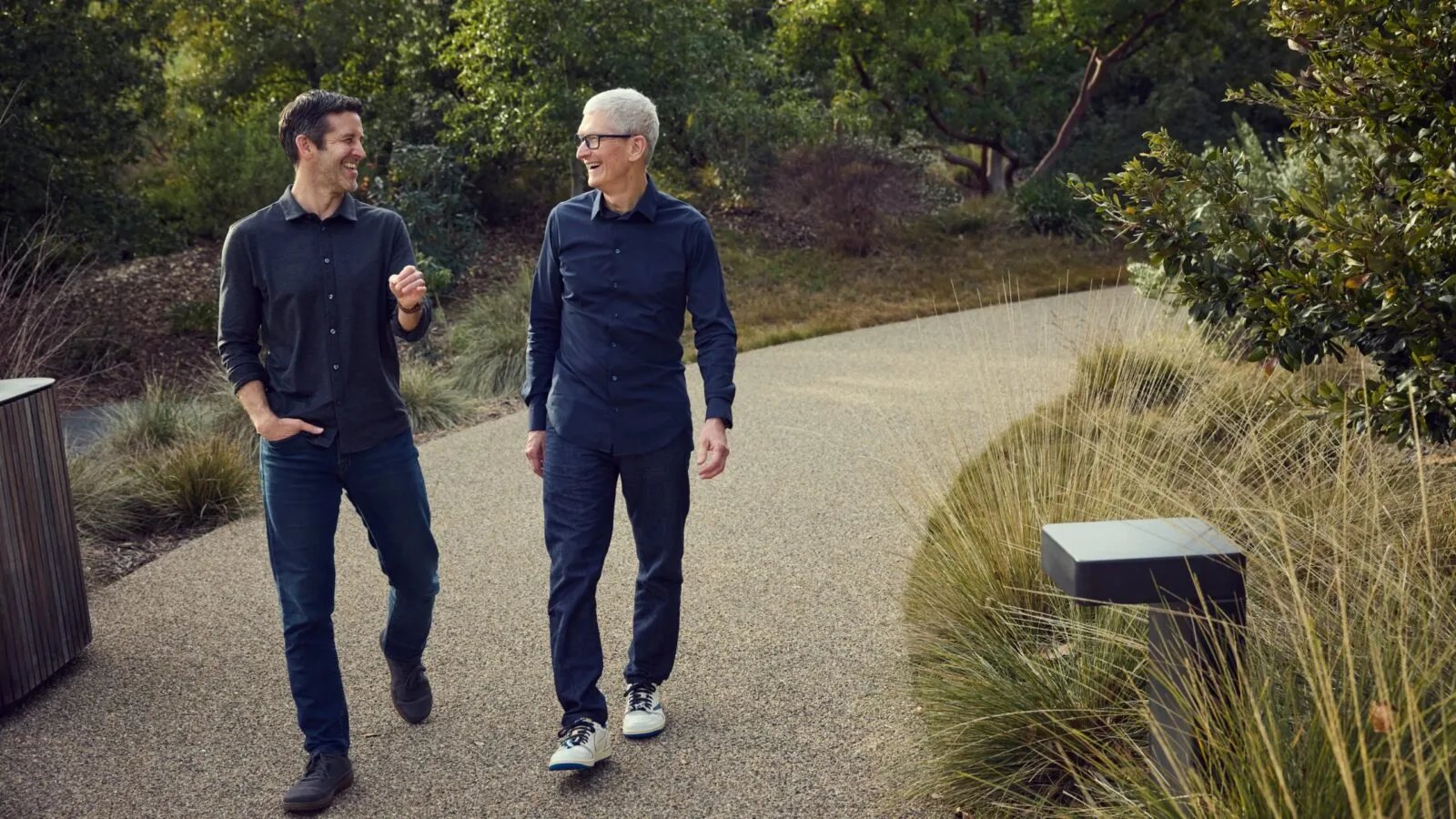


Tim Cook ends a 15-year run as Apple CEO
Tim Cook has led Apple since 2011, when he succeeded Steve Jobs. At the time, Apple’s market capitalization was approximately $350 billion. Today, the company is valued in the trillions.
Revenue tells an equally striking story. Apple generated roughly $108 billion in sales in fiscal 2011. By fiscal 2025, annual revenue had climbed to more than $416 billion.
Cook is therefore handing his successor a company several times larger than the one he inherited.
During his tenure, Apple also became much more than a company built primarily around the iPhone and Mac. Apple Watch, AirPods and Vision Pro created new hardware categories, while services including the App Store, iCloud, Apple Music, Apple Pay and Apple TV became one of the company’s most important businesses.
At the beginning of 2026, Apple said its installed base had surpassed 2.5 billion active devices worldwide.
Cook is not leaving the company. From September 1, he will become executive chairman of Apple’s board of directors and will continue to support selected strategic areas, including engagement with policymakers around the world.
John Ternus takes control of Apple
Apple’s new CEO is not an outsider.
John Ternus joined Apple’s Product Design team in 2001. He became a vice president of Hardware Engineering in 2013 and joined Apple’s executive team in 2021 as senior vice president of Hardware Engineering.
Over the years, he has overseen engineering work across virtually every major Apple hardware category, including the iPhone, iPad, Mac, Apple Watch, AirPods and Apple Vision Pro.
He was also one of the key executives involved in the Mac’s transition to Apple-designed silicon — one of Apple’s most important technological shifts of the past decade.
That background matters.
Choosing a longtime hardware engineering leader as CEO suggests that Apple still sees the integration of hardware, custom chips, operating systems and services as one of its most important competitive advantages.
Following the succession announcement, Johny Srouji was named Apple’s chief hardware officer, taking responsibility for both Hardware Engineering and Hardware Technologies.
The succession has been planned for months
The leadership change is not a surprise.
Apple formally announced its succession plan on April 20. The board approved the transition unanimously, and Cook has spent the summer working closely with Ternus to prepare for the handover.
Arthur Levinson, who has served as Apple’s non-executive chairman for the past 15 years, will become the company’s lead independent director on September 1.
Ternus will also join Apple’s board of directors.
Apple has therefore chosen a controlled transition rather than a clean break. Cook remains close to the company’s most important strategic decisions, while responsibility for day-to-day management moves to Ternus.
AI may be the biggest challenge facing the new CEO
Ternus is not taking over Apple at a quiet moment.
The world’s largest technology companies are spending tens of billions of dollars on artificial intelligence models, data centers, custom chips and new AI-powered devices.
Apple must define its own position in this race.
The company’s most important projects include Apple Intelligence and the continued transformation of Siri. At WWDC 2026, Apple presented a new generation of Siri powered by artificial intelligence, showing how central AI has become to its software strategy.
But Apple’s opportunity may extend far beyond building another large language model.
The company controls its processors, devices, operating systems and a large part of the software and services ecosystem running on them. If AI becomes deeply integrated into the iPhone, Mac, Apple Watch, AirPods and future wearable products, that combination could be difficult for competitors to replicate.
The challenge is speed.
Generative AI is developing extraordinarily quickly, and Apple must compete with companies that have been investing aggressively in models and computing infrastructure for years.
Apple is sharply increasing R&D spending
The scale of Apple’s current investments can be seen in its financial statements.
During the quarter ended June 27, 2026, Apple spent $11.73 billion on research and development, up 32% from $8.87 billion a year earlier.
During the first nine months of fiscal 2026, R&D spending reached $34.04 billion, compared with $25.68 billion in the same period a year earlier — an increase of 33%.
Research and development expenses represented around 11% of quarterly revenue.
That does not mean all of the additional spending is being directed toward artificial intelligence. Apple is simultaneously developing chips, software, devices, manufacturing technologies and entirely new product categories.
It does, however, illustrate the scale of investment taking place as the company enters its next leadership era.
Ternus is inheriting problems as well as record profits
The new CEO will also have to deal with more traditional operational challenges.
Apple has recently warned about significant supply constraints affecting advanced semiconductor manufacturing and memory.
The AI infrastructure boom has created intense competition for some of the world’s most advanced production capacity. That increasingly affects not only companies building data centers but also manufacturers of consumer electronics.
Apple reported revenue of $109.4 billion for the quarter ended June 27, up 16% year on year, making it the strongest June quarter in the company’s history.
But despite the strong results, its outlook disappointed parts of Wall Street.
Apple expected revenue growth of 9% to 11% in the September quarter, below the roughly 12% increase analysts had been expecting at the time. Executives attributed much of the gap to supply limitations rather than weak customer demand.
Ternus is therefore inheriting an exceptionally profitable company, but not one without pressure on its supply chain and margins.
His first major test comes on September 9
There will be no traditional 100-day grace period for Apple’s new CEO.
Just eight days after Ternus formally takes charge, Apple will hold a major product event on September 9.
The next generation of the iPhone is expected to be at the center of the presentation. One of the most closely watched possibilities is Apple’s first foldable iPhone, a device that industry sources and analysts have discussed for some time.
Apple has not officially confirmed the full product lineup, so details of individual devices should still be treated as unofficial until the presentation.
Regardless of what appears on stage, the event will carry symbolic importance.
For the first time, Ternus will lead Apple through one of its most important annual product launches as chief executive.
Hardware could become central again
The appointment of a longtime hardware executive may also provide clues about Apple’s longer-term direction.
The global smartphone market is mature, and annual upgrades increasingly deliver evolutionary rather than revolutionary changes.
Artificial intelligence could change that.
AI is creating new opportunities for personal devices that understand context, interpret the physical environment and interact with users in ways that go beyond traditional screens and apps.
The market has long speculated about Apple working on smart glasses, new home devices, additional wearables and products using cameras, microphones and other sensors to understand a user’s surroundings.
There is no guarantee that every experimental project will ever reach consumers.
But the strategic direction is becoming clearer: AI is likely to move from being a feature inside individual applications to becoming an intelligence layer embedded across the devices surrounding the user.
That could play directly to Apple’s traditional strengths.
Tim Cook leaves the bar exceptionally high
Tim Cook was never a second Steve Jobs — and he never tried to be.
Instead, he turned Apple into a much larger, more global and more predictable business.
He expanded the company’s services operations, scaled its manufacturing network, built a worldwide ecosystem of billions of active devices and increased annual revenue beyond $400 billion.
Ternus therefore inherits Apple from a position of enormous financial strength.
But he also faces a challenge that Cook did not confront during most of his tenure.
Generative artificial intelligence could reshape how people use smartphones and computers as profoundly as the mobile internet did in the previous era.
That means the defining question is no longer whether John Ternus can deliver another successful iPhone.
The real question is whether Apple under his leadership can establish as powerful a position in the age of artificial intelligence as it built in the age of the smartphone.



