
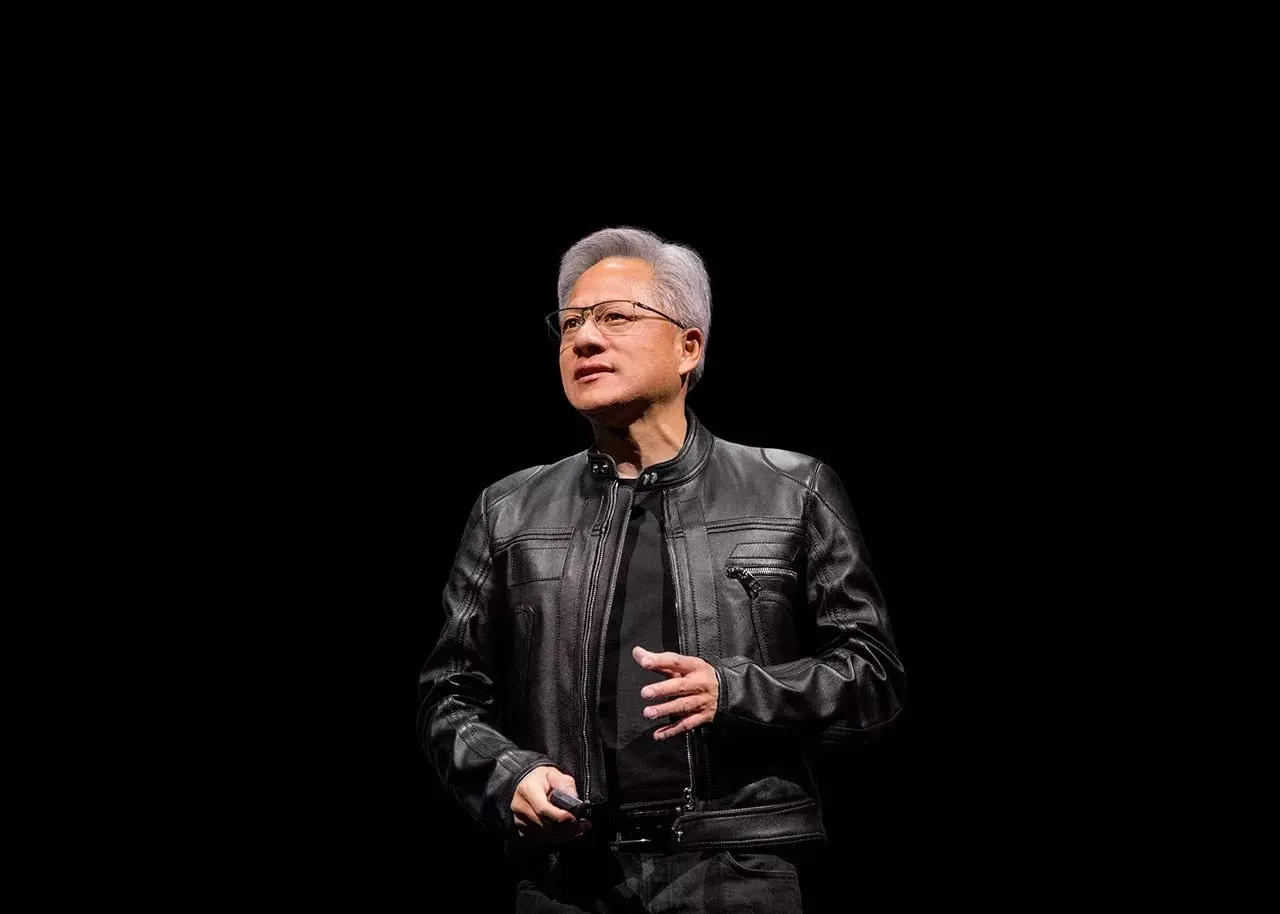


Cybersecurity could become one of the next major markets for artificial intelligence, according to Nvidia CEO Jensen Huang. As AI models become better at writing and analysing software, Huang expects more security tasks — from vulnerability detection to threat analysis and incident response — to become automated. For Nvidia, that could open an especially attractive market because security systems operate continuously rather than only when a user submits a prompt.
Huang discussed cybersecurity during the Goldman Sachs Communacopia + Technology Conference in San Francisco. He described it as a natural extension of capabilities that AI has already developed in software engineering.
“The derivative of coding is, of course, finding bugs,” Huang said.
The broader opportunity is not limited to debugging. An AI coding assistant works when a developer gives it a task. A corporate security system, by contrast, has to run constantly — watching networks, analysing user behaviour, identifying anomalies, comparing them with known attack patterns and reacting before an intruder can move deeper into the environment.
That always-on workload could create a new category of demand for AI infrastructure.
Attackers are getting faster
CrowdStrike said in its 2026 Global Threat Report that activity involving adversaries using AI increased by 89% in 2025. The average breakout time — the period between initial access and the start of lateral movement inside a compromised environment — fell to 29 minutes.
In the most extreme case observed by the company, the process took just 27 seconds.
These figures do not mean that every cyberattack has become autonomous, and they come from CrowdStrike’s own telemetry rather than the entire global market. They do, however, illustrate the direction of travel: AI can help attackers conduct reconnaissance, prepare campaigns, evade controls and scale operations more quickly.
That creates pressure on defenders to respond at machine speed. If attacks unfold in minutes or seconds, human analysts may not have enough time to detect, assess and contain them manually.
Nvidia and CrowdStrike are building systems where AI tests AI
Nvidia is already positioning itself in this market. On 1 September, CrowdStrike presented SafeMind, an agentic cybersecurity system developed using Nvidia Nemotron models and designed to operate within the Falcon platform.
The concept relies on a continuous contest between offensive and defensive AI. One model searches for possible attack paths, while another attempts to detect and close them. The cycle is repeated so both sides continually test their capabilities.
This differs from traditional security approaches that depend heavily on predefined rules and known indicators. In an agentic system, AI is expected not only to detect a problem but also to interpret context, choose a response and participate in remediation.
CrowdStrike says SafeMind is trained and tested using Falcon telemetry, while Nvidia supplies Nemotron models and the underlying technology required to run the system.
Cybersecurity offers a different type of AI demand
From Nvidia’s perspective, the key distinction between cybersecurity and many current AI applications is frequency of use.
A chatbot waits for a question. An analytical tool receives a document. An employee assistant is activated for a specific task. Security infrastructure cannot simply stop when one task is complete.
It has to monitor events 24 hours a day.
If companies begin deploying specialised AI agents for this purpose, computing demand could become much more continuous than in many existing assistant-based applications. That is why cybersecurity matters to Nvidia not just as another AI feature, but as a potential new category of persistent infrastructure usage.
Nvidia is counting on another huge investment cycle
The business stakes are significant. Nvidia closed the second quarter of fiscal 2027 with revenue of USD 96.2 billion, up 106% from a year earlier. Data-centre revenue reached USD 89 billion, rising 117% year on year.
The company has also indicated that fiscal 2028 revenue could increase by around 70% from the previous year, while supply remains one of the main constraints on further growth.
This means Nvidia is not only looking for more customers for today’s AI applications. It also needs new categories of workloads that justify continued expansion of computing infrastructure by enterprises and data-centre operators.
Cybersecurity fits that strategy well.
Up to USD 4 trillion a year in AI infrastructure
Nvidia’s broader market forecast is even larger. The company believes annual global investment in AI infrastructure could reach USD 3–4 trillion by the end of the decade.
The figure refers to annual spending at that point, not a cumulative total over several years.
Nvidia expects growth to come not only from larger language models but from AI expanding into enterprise software, autonomous agents, robotics, industrial systems and cybersecurity.
A wide range of always-on applications would help support the next wave of investment in global computing infrastructure.
Huang is less pessimistic than some AI executives
The cybersecurity opportunity is emerging at the same time as concerns about advanced AI capabilities are growing in Silicon Valley.
Huang has taken a more optimistic position than some other industry leaders. According to Axios, he also suggested that concern about new AI-driven threats can itself create demand for tools designed to defend against them.
That dynamic could benefit Nvidia on both sides. Greater AI adoption increases demand for the infrastructure required to run the technology. If AI also increases the speed and scale of cyber threats, companies may need additional AI systems to protect that same infrastructure.
Nvidia does not need to become a cybersecurity company
That may be the most important part of the strategy.
Nvidia does not necessarily need to compete directly with CrowdStrike, Cisco or other security vendors. A more attractive model may be to let other companies build cybersecurity applications and services while Nvidia provides the computing layer, models and infrastructure that power them.
The company already uses a similar approach across much of the AI market.
If autonomous security systems become a standard part of large-company infrastructure, cybersecurity could evolve from another AI use case into a market where models run continuously — and where the infrastructure required to support them is also used around the clock.
Sources: Nvidia Q2 FY2027 results, 26 August 2026; Nvidia at Goldman Sachs Communacopia + Technology Conference, 10 September 2026; Nvidia/CrowdStrike at Fal.Con 2026, 1 September 2026; CrowdStrike 2026 Global Threat Report; Reuters; Axios; Business Insider.
Original Polish article: ManagerPlus.pl



