


Poland’s biomethane market is still at an early stage, but investor interest is increasing. Polska Spółka Gazownictwa has already issued around 500 grid-connection conditions for biomethane plants and signed 25 agreements. The first agricultural biomethane facility connected to the gas network is operating in Komorów in the Mazovia region. Further projects could be supported by an amendment to the Renewable Energy Sources Act introducing support for larger installations.
Farmers and food-processing companies are increasingly looking for additional sources of income and ways to use agricultural waste. Agriculture Minister Stefan Krajewski told Newseria that biogas and biomethane plants can turn slurry, manure and other production residues into energy while also creating a usable digestate by-product.
According to data from the National Support Centre for Agriculture (KOWR), the number of agricultural biogas plants is rising steadily. At the end of May 2026, the register included 209 installations with combined annual capacity of around 840 million cubic metres of biogas and 11 million cubic metres of biomethane. In 2025, agricultural biogas plants produced nearly 1.1 TWh of electricity, 6.6% more than a year earlier.
About 7.7 million tonnes of feedstock were used for agricultural biogas production in 2025, with waste accounting for around 91%. The main materials included distillery residues, slurry and fruit and vegetable waste. Fermentation produced more than 6.1 million tonnes of digestate.
Energy Minister Miłosz Motyka estimates that the long-term potential of biogas and biomethane in Poland could approach 8 billion cubic metres by 2040. In his assessment, the two fuels could replace around 20–25% of Poland’s total gas consumption and reduce import dependence.
Polska Spółka Gazownictwa CEO Szymon Paweł Moś stressed that biomethane has the same basic characteristics as natural gas but can be produced domestically from Polish feedstock. Unlike solar or wind power, biomethane production can operate continuously if feedstock is available.
Current production remains small. In 2025, around 2,500 cubic metres of biomethane were produced from agricultural biogas and injected into the gas grid. The Komorów plant is the second biomethane facility connected to the PSG network after an installation at the Strzelin sugar plant, but it is the first agricultural biomethane plant connected to the system.
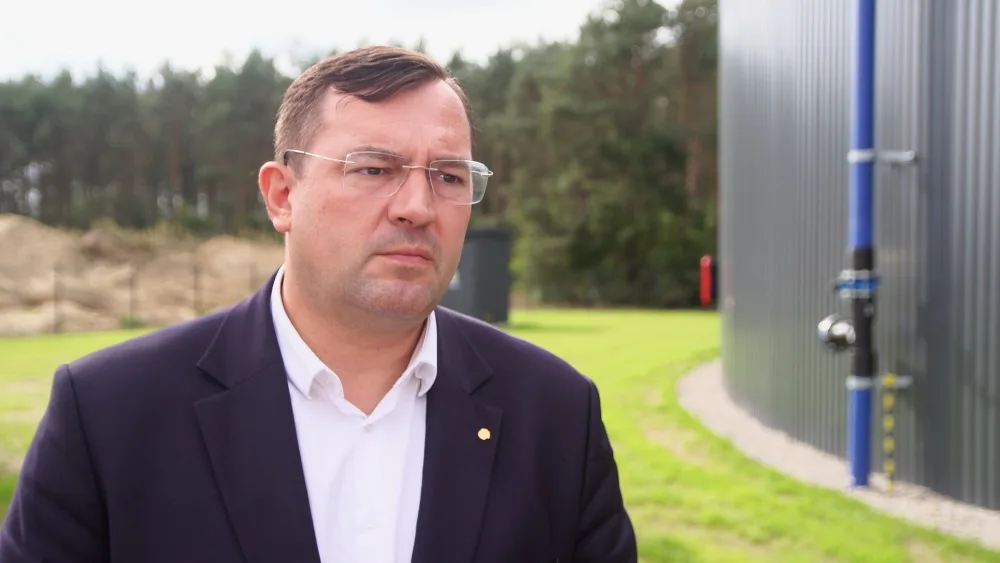
The Agro-Biogas plant in Komorów mainly uses slurry and manure from three farms and is expected to process nearly 60,000 tonnes of agricultural waste per year. The facility has around 2.5 MW of biomethane output capacity and produces approximately 20,000 MWh of gas annually.
PSG built a connection with capacity of 250 cubic metres per hour, allowing more than 2 million cubic metres of gas to be injected into the network each year. The infrastructure was designed with future expansion in mind.
Interest in new projects is growing quickly. PSG has issued around 500 connection conditions and signed 25 agreements. Based on current investor declarations, another 12 biomethane plants are expected to connect to the network in 2027.
PSG operates around 215,000 kilometres of gas distribution pipelines. The company estimates that 3–4 billion cubic metres of biomethane could eventually be injected into its network annually. For comparison, Poland’s gas demand in 2035 is estimated at around 27 billion cubic metres.
The sector is also waiting for new legislation. The amendment to the Renewable Energy Sources Act, adopted by the Sejm on September 4 and approved by the Senate without amendments on September 24, provides for an auction-based support system for biomethane plants above 1 MW. It also introduces rules for direct gas pipelines connecting producers with consumers.
Industry representatives argue that predictable support and simpler regulations will be important if Poland is to accelerate investment in agricultural biogas and biomethane over the next several years.



